Most of my students have left for home already. I do have a 6:00 class which I must get to in just a moment--maybe there are one or two students left who need me. In between classes, I've been reading about the poet John Berryman, one of the "confessional" poets I plan to discuss in "From Angst to Art" next semester. In the Introduction to Berryman's collected poems, Charles Thornbury reveals that Berryman was a man of great intensity, even when he read. In a letter to his mother, Berryman describes reading Crime and Punishment:
How shall I tell you how I am reading it? As if I were driving a pack of hounds through a wood, feverishly; only every tree and bush is so unbearably interesting and exciting that I'd like to stop and examine it for a long time, but the hounds are off ahead and won't stop. ... My faculties are raging out in front of me. I haven't felt so powerfully in a long time. Even my unhappiness is acute, sharp, engaging.
Here, I think, Berryman does describe what it feels like to read a great book.
Showing posts with label reading. Show all posts
Showing posts with label reading. Show all posts
Tuesday, November 21, 2006
Thursday, September 14, 2006
Books are alive
I was riding in the elevator at the university with a stranger the other day. She seemed about the age of most graduate students, mid twenties, perhaps. She wore a bright long scarf over her hair and had dark skin. Perhaps Indian, I thought. She had those eyes, honest and sincere, as though she were looking into me. And she kept looking into me, so I smiled.
She said, "You teach literature, don't you?" I said I did, and she asked if I liked doing that. I said I did like it very much, that literature teaches us the meaning of the world. She smiled radiantly and said, "It teaches us the meaning of LIFE."
We who love literature know its power to teach and to change. You can still give this gift to yourself. Remember how you loved to read and write when you were young, and embrace it all again in newness and wonder. It's still good. Books are alive.
She said, "You teach literature, don't you?" I said I did, and she asked if I liked doing that. I said I did like it very much, that literature teaches us the meaning of the world. She smiled radiantly and said, "It teaches us the meaning of LIFE."
We who love literature know its power to teach and to change. You can still give this gift to yourself. Remember how you loved to read and write when you were young, and embrace it all again in newness and wonder. It's still good. Books are alive.
Saturday, July 29, 2006
The Big Flea Market
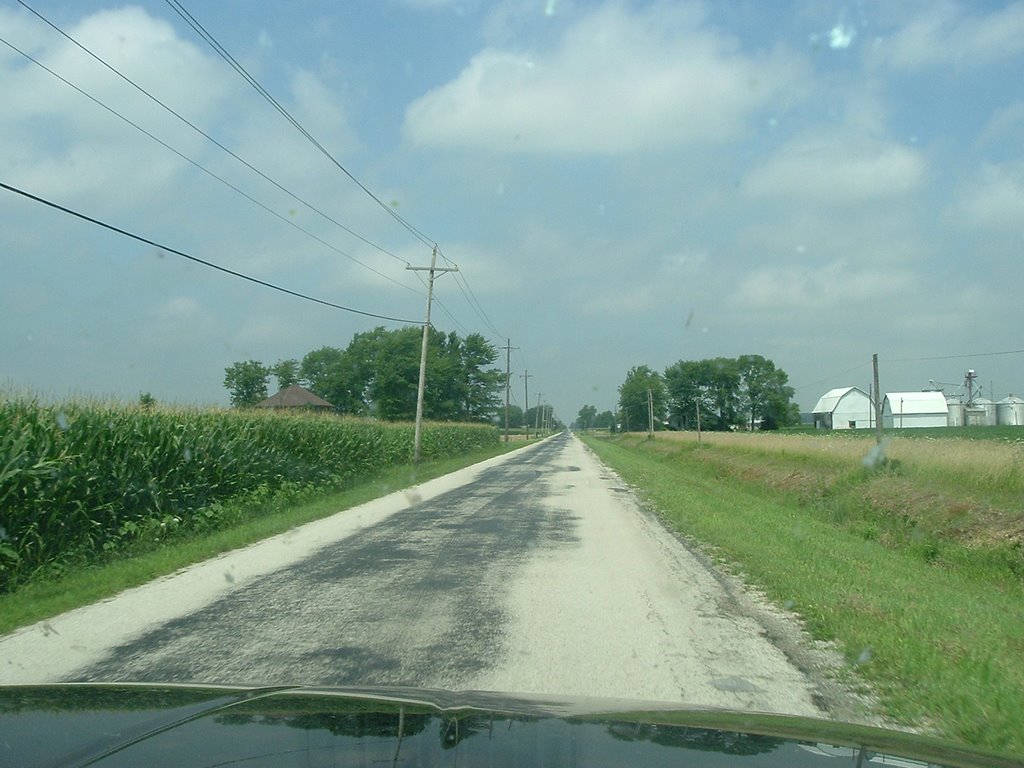
On impulse, I snapped this photo through the windshield of our truck on our way to the Big Flea Market. This is a road that runs beside our house. Sometimes when I'm riding in a vehicle, I look at the Northwest Ohio landscape and it seems surreal. This happens especially when the roads are bathed in a certain kind of yellow light. It happens also after it has snowed and the wind is blowing snow across the road or when the blowing snow makes patterns on the road like writhing snakes. The flatness of the land, the perspective created by electrical lines and poles, and the vastness of the sky speak strongly to me of destiny. But where am I going, and why?
Yesterday, in the boiling heat, Allen, Buddha, and I went to a big flea market in a city very near us. It's a 3-day celebration that people look forward to here every year, but I can't remember it ever being this hot when it was going on.
What I remember most from yesterday:
1) Item: A cast iron mermaid (about 3/4 life sized)
2) Item: A pocket Bible with a delicate picture of Mary on the front, circa 1800's.
3) Place: The low part of the field, soggy from the previous day's rain. My sandaled feet wet from sinking in the cool water covering the grass.
I bought three books, paying for them $2.25 and two pair of pants for Allen, totaling $4.00, grand total: $6.25.
The books:
1) A college edition of Art History, for making my collages.
2) The Works of Oscar Wilde, copyright 1927. This book looks identical to the Checkov volume I purchased in Vermont and is published by the same company, The Walter J. Black Co. The Checkov volume is worn, due to heavy reading and handling from being in the public library. However, the Oscar Wilde volume looks virtually unread.
From "Rosa Mystica" by Oscar Wilde:
To drift with every passion till my
soul
Is a stringed lute on which all winds
can play.
Is it for this that I have give away
Mine ancient wisdom, and austere
control?
3) The Best American Short Stories 1943. I own several volumes of the best American Short Stories, but this is the earliest edition I've found so far. The inscription inside reads: "Belated Birthday Wishes to Frank from Andy." The book's dedication is to:
"Irwin Shaw, Private, U.S. Army" and "To All Writers Enlisted in a Great Task."
Isn't that wonderful? What is my "great task"? What is yours?
Authors of a few of the best stories of 1943 include: William Faulkner ("The Bear"); William Saroyan ("Knife-Like, Flower-Like, Like Nothing At All in the World"); Eudora Welty ("Asphodel") and James Thurber ("The Catbird Seat"). Who doesn't remember "The Catbird Seat" from highschool or college freshman comp.?!
I like to study authors' first lines. Here are a few from The Best American Short Stories 1943:
"The smell around the training farm was compact like a wall, rising from the ground which was muddy with yesterday's rain, and surrounding the chicken coops huddled white in the muffled dark night." --Vicki Baum, "This Healthy Life"
"Ora Larrabie stayed still as long as she could hold the wonder to herself." --Rachel Field, "Beginning of Wisdom"
"Eunice looked at me across the table and said: 'I've a corking idea for a novel.'" --Vardis Fisher, "A Partnership with Death"
"The Isle of Man is a very small fragment of the British Commonwealth of Nations and a place you never hear much about." --Grace Flandrau, "What Do You See, Dear Enid?"
"Last May you were married, and now this morning your widow is wailing." --Peter Gray, "Threnody for Stelios"
And my two (so far) favorites:
"As they all knew, the drive would take them about four hours, all the way to Weed, where she came from." --Paul Horgan, "The Peach Stone"
"One evening when Ellen Goodrich had just returned from the office to her room in Chelsea, she heard a light knock on her door." --John Cheever, "The Pleasures of Solitude"
I think Cheever's is my favorite of all. What is better than starting a story with a knock on the door?
Any story I have ever loved has been like a experiencing a knock on my door. It has been an invitation to mystery and transformation.
After the flea market we came home and cooked hotdogs, bathed, and went to the hospital to visit someone we love.
Thursday, July 20, 2006

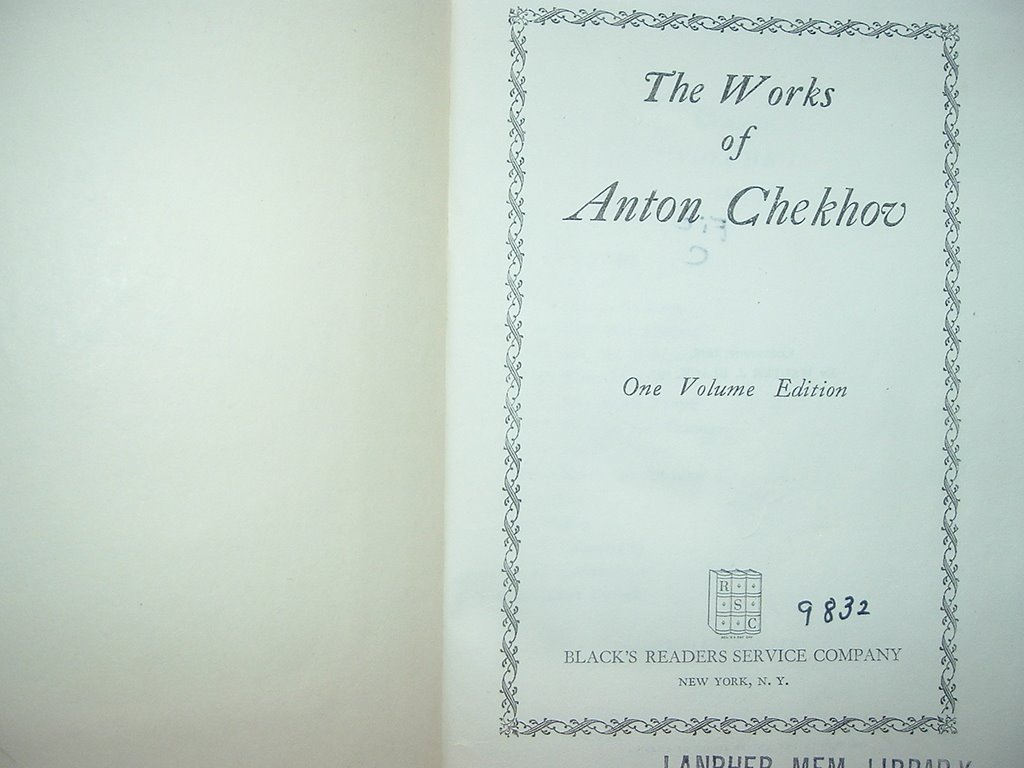

Treasure! The collection of Anton Checkov's works, bought at a library sale in Stowe, Vermont.
This book was an incredible find, yet there is something sad about seeing such a treasure stamped with the word, DISCARDED. This edition of Checkov's works was published in 1929.
Checkov, a graduate of medical school, wanted to write stories that looked at people and situations somewhat objectively. His lack of personal commentary (and judgment) combined with his keen insights into the human psyche made him a great storyteller.
My favorite of his stories so far is "La Gigale." It is about an artistic, although flighty, young woman named Olga who marries a man of science, Dymov. At first Olga sees beyond Dymov's meek demeanor and recognizes his greatness: his dedication, intelligence, and compassion. Later, she tires of him and has an affair with one of her artist friends. Dymov knows of the affair but wants to keep the marriage together. In this pivotal scene, Olga has the opportunity to make things right, but she fails to recognize the potential for transformation:
One evening when [Olga] was preparing to go to the theater, she was standing before the pier-glass when Dymov, clad in a dress-coat and a white tie, came into her bedroom; he smiled meekly and as formerly he looked his wife joyfully straight in the eyes. His face beamed.
"I have just been defending my thesis," he said, sitting down and stroking his knees.
"Defending?" Olga Ivonovna asked.
"Ogo!" he laughed, and he stretched his neck in order to see his wife's face in the mirror, as she was still standing before it with her back towards him arranging her hair. "Ogo!" he repeated. "Do you know it is very probable I shall be offered the post of professor's substitute on general pathology. It looks very like it."
It was evident by his delight and his beaming face that if Olga Ivanovna had shared his happiness and triumph he would have forgiven her everything, the present and the future, and he would have forgotten everything, but she did not understand what the post of professor's substitute or general pathology meant; besides, she was afraid of being late for the theatre and said nothing.
He sat for two minutes, smiled culpably and then left the room.
.........................................................
He sat for TWO MINUTES! That's a long time to sit silently, waiting for someone to respond favorably to a grace extended. He has been direct, looking her staight in the eyes and expressing his intimate joy. But she keeps her back to him, experiencing his presence obliquely, through the mirror. I love the detail of his stroking his knees, the part of the body that most strongly, I think, suggests humility (as we get on our knees when we pray or give homage to another). Also the detail, "...he left the room," a physical and psychological distancing.
I look forward to reading all of Checkov's works. How strange that I had to go all the way to Vermont to discover him.


The library in Stowe, Vermont where I found my fantastic collection of works by Checkov, as well as Anne Morrow Lindburgh's Diaries and letters. Looking through Lindburgh's writings later that day, I was saddened at how she accepted that being a woman was something less substantial than being a man. This was particularly evident in an entry about a discussion she had with the author of The Little Prince while waiting for her husband to arrive: "I am feeding the dogs when C. finally appears--it is almost 10. I drop back in relief, I am so glad he is there. We (St. -Ex. and I) both leap at him with the relief of thirsty travelers needing water. C. blows in like a sea breeze. But he is tired, driving all day in traffic. However, he takes his supper on a tray and over the tray carries on the torch of conversation, which immediately goes up a level, takes on a higher, less feminine tone." I sometimes wonder if what she thought of as "feminine" was really her more quiet, introspective nature as opposed to her husband's more extroverted personality. I know that often I feel inadequate during conversations because my thoughts are vague, diffused, like looking through a glass darkly. I've often wished I was more lively and able to carry the torch, like Charles Lindburgh.
Friday, February 03, 2006
Let Us Now Praise Famous Men
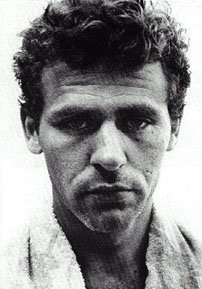
Some of you who used to visit my AOL Journal (before AOL tacked Ads on our journals and many of us left), may remember that I did an entry on James Agee. In that entry, I wrote of how I'd loved his novel, A Death In The Family from my first reading of it when I was 13. I'm writing about Agee again because I've just finished reading Let Us Now Praise Famous Men, which can be bought in a gorgeous Library of America edition. This edition also includes A Death In The Family and other Agee writings.
The blurb on the back of the book says: "In Let Us Now Praise Famous Men, Agee invented a new genre to convey his stark vision of the lives of Alabama tenant farmers." We are all used to blurbs being exaggerations; however this claim "new genre" is not an exaggeration. I have never see anything like Famous Men before.
I implore you, do not, do not be swayed by the negative reviews of Let Us Now Praise Famous Men. If you are looking for a book that is deeply engrossing, challenging, different, and enlightening, then this is a book you should read. It's not for the squeamish, nor for those who don't like to pry up the rotting boards and peer into the darkness.
In Famous Men, Agee addresses the difference between fiction and non-fiction by saying: "In a novel, a house or person has his meaning, his existence, entirely through the writer. Here, a house or a person has only the most limited of his meaning through me: his true meaning is much huger." It's perhaps this interest of mine in the craft of writing itself that has made Famous Men so fascinating to me. This is at once a book about the tenant farmers and a book about the difficulty of writing about them.
Another thing: In the beginning pages, Agee writes with absolute humility towards his own writing and his subject matter. This was stunning to me, because I've also read Agee's movie reviews, and in those writings Agee is witty, merciless, honest, and very confident in his own opinion. In short, they are some of the best movie reviews I have ever read.
However, Famous Men is another kind of writing altogether. As Agee admits, his efforts to capture his subject matter through words were a failure. Words are inefficient, inadequate in matters so huge. He wrote: "If I could do it, I'd do no writing at all here. It would be photographs; the rest would be fragments of cloth, bits of cotton, lumps of earth, records of speech, pieces of wood and iron, phials of odors, plates of food and of excrement."
That Famous Men is not more popular does not surprise me, nor was Agee surprised, I think, when the book got bad reviews and suffered poor sales. Famous Men, I think, is not the sort of book that would ever gain wide acceptance. It is a flawed masterpiece that takes a lot of work to absorb, but well worth the effort. I don't know the extent to which Agee may have been devastated, nonetheless, at the way America turned its back on his masterpiece. I do know that Agee seemed to suggest in the early pages of Famous Men that the worst thing that can happen to any artist is mass acceptance.
Perhaps mass acceptance is something the writer both wants and fears; I don't know. But Agee does say in Famous Men that he felt that as soon as, say, Beethoven's music is used as a form of relaxation or as a background to the mundane activities human beings inevitably become so wrapped up in, then the music has lost its vitality.
That is why Agee suggests in Famous Men: "Get a radio or a phonograph capable of the most extreme loudness possible, and sit down to listen to a performance of Beethoven's Seventh Symphony or of Schubert's C-Major Symphony. But I don't mean just sit down and listen. I mean this: Turn it on as loud as you can get it. Then get down onto floor and jam your ear as close into the loudspeaker as you can get it and stay there, breathing as lightly as possible, and not moving, and neither eating nor smoking nor drinking. Concentrate everything you can into your hearing and into your body. You won't hear it nicely. If it hurts you, be glad of it."
The same might be said for Famous Men. If you concentrate, you will hear Famous Men in your whole body. And if it hurts you, you will be glad.
Subscribe to:
Posts (Atom)
Subscribe To


 Posts
All Comments
Posts
All Comments
Dreaming
About Me
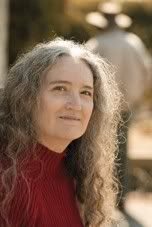
- Theresa Williams
- Northwest Ohio, United States
- "I was no better than dust, yet you cannot replace me. . . Take the soft dust in your hand--does it stir: does it sing? Has it lips and a heart? Does it open its eyes to the sun? Does it run, does it dream, does it burn with a secret, or tremble In terror of death? Or ache with tremendous decisions?. . ." --Conrad Aiken
Facebook Badge

Subscribe
Posts
All Comments
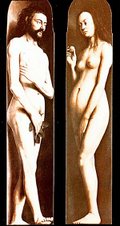
Fave Painting: Eden
Fave Painting: The Three Ages of Man and Death
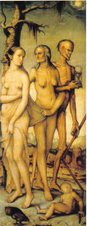
by Albrecht Dürer
My Original Artwork: Triptych
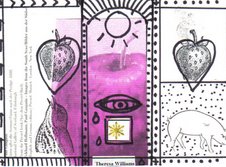
Wishing
Little Deer
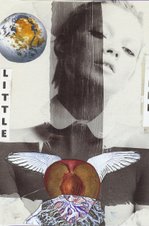
Transformation
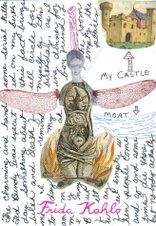
Looking Forward, Looking Back