When the ground is snow-covered you really wonder why this isn't called Winter Semester.
I looked around my livingroom this afternoon. Since we gave up TV, the chairs are no longer pointed at the tube. They are pointed at the woodheater. This is one reason why I love winter, the woodheater. I love it that fire is the focal point of our house. I always feel sad when spring arrives and the heater goes dead.
I am excited to think of my students reading James Wright and Georg Trakl together.
Showing posts with label James Wright. Show all posts
Showing posts with label James Wright. Show all posts
Thursday, January 14, 2010


Sunday, January 28, 2007
When Things Come Together
 Photo: Poster for Pan's Labyrinth
I've noticed that when I stay close to my creative life, things can come together in the most unpredictable ways.
Such a happy occurrence happened this month, when my studies of Federico Garcia Lorca's essay on the "Duende," my reading of Lorca's poetry, and the opportunity to see Pan's Labyrinth all came together. Pan's Labyrinth never mentions Lorca, but it is set during the Spanish Civil War, during which Lorca was killed by firing squad.
It would be easy to write a spoiler review of Pan's Labyrinth. I don't want to rob anyone of the delight and the horror that awaits. I will say, however, that I was delighted to see women in such prominent roles, strong women, and delighted by the way fairytale and reality are woven together in such a way that you are made to question which is "reality." The movie is very rich, but it is disturbing at times, and even gory, in the way of Grimm Fairytales and 20Th Century War.
Pan's Labyrinth, I think, evokes what Lorca called "Duende"; it is a work of art composed of black notes. It is a story saturated from the roots up with themes of death and regeneration.
Lorca was a beautiful poet and human being. He was almost a Spanish version of William Blake, except Lorca fastened his attention much more on death than Blake. To understand Lorca, or even to begin to (and I make no claims of understanding Lorca), you have to be able to understand the fascination Spanish culture has with death, as expressed through bull fighting and also the dark, sad songs of the gypsies: "deep songs," Lorca called them. I came to Lorca through my study of James Wright and other American poets who discovered the Spanish poets and immersed themselves in their poems. I believe it was largely as a result of discovering the Spanish poets that Wright found, at last, his voice. Although death is at the heart, a wonderful spirit of transcendence marks the work of the Spanish poets.
Lorca believed intensely in the beauty of art and wrote poems with playful and often wild juxtapositions of imagery, such as in this poem:
Nobody is asleep on earth. Nobody, nobody.
Nobody is asleep.
In a graveyard far off there is a corpse
who has moaned for three years
because of a dry countryside on his knee;
and that boy they buried this morning cried so much
it was necessary to call out the dogs to keep him quiet.
Life is not a dream.Careful!Careful!Careful!
We fall down the stairs in order to eat the moist earth
or we climb to the knife edge of the snow with the voices of the dead
dahlias.
But forgetfulness does not exist, dreams do not exist;
flesh exists. Kisses tie our mouths
in a thicket of new veins,
and whoever his pain pains will feel that pain forever
and whoever is afraid of death will carry it on his shoulders.
One day
the horses will live in the saloons
and the enraged ants
will throw themselves on the yellow skies that take refuge in the
eyes of cows.
Another day
we will watch the preserved butterflies rise from the dead
and still walking through a country of gray sponges and silent boats
we will watch our ring flash and roses spring from our tongue.
Careful!Be careful!Be careful!
The men who still have marks of the claw and the thunderstorm,
and that boy who cries because he has never heard of the invention
of the bridge,
or that dead man who possesses now only his head and a shoe,
we must carry them to the wall where the iguanas and the snakes
are waiting,
where the bear's teeth are waiting,
where the mummified hand of the boy is waiting,
and the hair of the camel stands on end with a violent blue shudder.
--------------------------------------------------
Lorca's poems give the rational mind fits, but I think few people can deny the genius and the duende (soul) of these lines:
we will watch the preserved butterflies rise from the dead
and still walking through a country of gray sponges and silent boats
we will watch our ring flash and roses spring from our tongue.
May I be fortunate enough to live long enough to see such a day.
These lines were later shaped a new way by James Wright, who wrote of the human body being about ready to break into blossom.
Tuesday, January 02, 2007
Throwing off routine

 Top photo: Ohio River at Martins Ferry
Bottom photo: Broken shaft from the John Porter: monument to yellow fever victims at Gallipolis.
Allen and I felt we had gotten into a rut lately. So when several favorable situations converged, making travel possible over New Year's, we took a two day road trip along the Ohio River. We went to Wheeling, West Virgina and spent the night; then to Martins Ferry, OH, Parkersburg, West Virginia, Pomeroy, OH and Gallipolis, OH.
My main goal was to get some video footage of the river for a film I want to make about James Wright for my seminar next semester. That's why we started in Wheeling and Martins Ferry--that's where Wright grew up. Admittedly, I am in the rudimentary stages in my film-making abilities, but film as a vehicle for story-telling excites me just now.
The weather was unseasonably warm, cloudy and still the first day at Martins Ferry. We stood at the same spot at which we landed back in 2004 with our boat during our Ohio River journey. Just off to the right, there, is a stand of willows--that is where we spent the night in our boat back then.
Afterwards, we drove to Pomeroy and Gallipolis because we had such fond memories of both places. It was colder on the second day, and windy. The river was choppy. The second photo is a partial depiction of an unusual monument in Gallipolis to yellow fever victims. That is a broken rocker shaft from the John Porter from New Orleans. The broken shaft kept the boat from proceeding further than Gallipolis. Passengers aboard the John Porter carried Yellow Fever, which spread among the people at Gallipolis, killing 66 in 1878.
I like the monument. I remembered it after returning from the river journey, but I had no photo of it. I was happy to be able to get a photo this time. As much as being a monument to the 66 who died, this is a monument to chance. The shaft is an agent of chance. Had it never broken, history would have been different. Looking at the shaft, I'm invited to wonder at what small object might play a role in my own destiny. The shaft reminds me that I can't control every situation in my life.
We spent New Year's Eve in a motel at Parkersburg. I think this is the first time in my life I've ever spent New Year's Eve in a motel room. Maybe a motel room is the perfect symbol for where I am in my life just now. Motel rooms are at once public and private spaces. In many ways, art is the same. It comes from an intimate space, yet it occupies a public space. Somehow the artist has to reconcile these two extremes. I lay awake all night thinking of all sorts of creative projects I'd like to do. This short trip was very good for the imagination.
It's good to get away from the familiar haunts of your life now and then. The imagination thrives when you can throw off your routines and expectations.
In other words, I had fun.
Saturday, December 02, 2006
Hy Sobiloff's Child Within
From a poem by Hy Sobiloff:
Speak to me child speak to me
You are learning
Yet you may teach me again the sweetness and the curdle
And tell me of the kid that is nursing under the sapodilla tree
And of the seashell I lost
And of those first scenes that I've forgotten
Speak to me of the innocence in the wading pond
That survives somewhere (I shall comment on the miracle)
Open your secrets to me
While I stare at your stare
Show me the buzzard ugly enough to die
The ground dove that has a hermitage
Tell me of the dogs that are better than cats
Cats cannot catch goats
Explain why that child is sitting by the road
Nodding and shaking and no-one there
I shall give you a biscuit
And let you eat it with dirty hands...
Promise me child before you disappear in hide-and-seek
That your next step will be the fiction of this world
That when you leave the broken wall
You will keep your lizard spontaneities...
-----------------------------------------
In 1963, the poet James Wright wrote an introduction to Hyman Sibiloff's poetry collection "Breathing of First Things." In this introduction, Wright seems to chide those who see the quest for the child within as naive or, worse (for Wright), unmanly. Wright says that the rediscovery of what he calls the true self, with its healing powers, necessarily involves a search for the child within, which he equates with the ability to experience wonder through the senses, the ability to see the miraculousness of things, to feel truly alive. In the introduction, Wright says:
"[...] the struggle to be true to one's own self involves a good deal more than the rediscovery of a childlike radiance and joy, though that rediscovery may lie at the end of the journey. The journey itself is a dark one. It is neither more nor less than the attempt to locate and reclaim those healing powers within one's self that are able to provide sufficient courage and literal physical strength for one to confront and overcome the agonies of the world which exists beyond the womb and which, for better or worse, does not happen to be shaped and arranged in a pattern identical with the orchards and rivers and meadows of that earliest garden, sunken now almost below the memory and, whether wasted or redeemed, lost somewhere between the morning of dancing animals and the tousled dusk of sorrowing human faces. Beyond that garden we live a good deal of our death. We may insist on returning to seek it by trying to ignore the shocks and miseries that obstruct the only true way back home; and such evasions really amount to a mere refusal to live. The refusal, the negation, the despair--these are our constant familiar spirits in the twentieth century."
---------------------------------------
Wright describes the journey back to self as a dark one; I think I agree with him. But there are moments of epiphany, of light. An example is found in Sobiloff's poem. The lines in Sobiloff's poem that speak to me the most are: "I shall give you a biscuit/
And let you eat it with dirty hands..."
The reason why those lines are meaningful to me is that I got an immediate image, upon reading them, of myself, very small, innocently eating a biscuit with my dirty hands. I remembered having eaten food with dirty hands, after just coming in from a hard day of play, good play, my hands scooping dirt and all my senses alive, picking up things, exploring them with my hands, feet, and mouth. There is such an honesty in the image of a child with dirty hands. Wright also points out that Rilke understood the power of returning to a child's wonder: "'Every door in me opens,' said Rilke, 'and my whole childhood stands all around me.'"
In one of Wright's own poems, "The Journey," in the final stanza, he writes:
...The secret
of this journey is to let the wind
Blow its dust all over your body,
To let it go on blowing, to step lightly, lightly
All the way through your ruins ...
Such a gorgeous, sensory moment.
I have more to say about this topic, but I need to let my thoughts compost a while longer.
Speak to me child speak to me
You are learning
Yet you may teach me again the sweetness and the curdle
And tell me of the kid that is nursing under the sapodilla tree
And of the seashell I lost
And of those first scenes that I've forgotten
Speak to me of the innocence in the wading pond
That survives somewhere (I shall comment on the miracle)
Open your secrets to me
While I stare at your stare
Show me the buzzard ugly enough to die
The ground dove that has a hermitage
Tell me of the dogs that are better than cats
Cats cannot catch goats
Explain why that child is sitting by the road
Nodding and shaking and no-one there
I shall give you a biscuit
And let you eat it with dirty hands...
Promise me child before you disappear in hide-and-seek
That your next step will be the fiction of this world
That when you leave the broken wall
You will keep your lizard spontaneities...
-----------------------------------------
In 1963, the poet James Wright wrote an introduction to Hyman Sibiloff's poetry collection "Breathing of First Things." In this introduction, Wright seems to chide those who see the quest for the child within as naive or, worse (for Wright), unmanly. Wright says that the rediscovery of what he calls the true self, with its healing powers, necessarily involves a search for the child within, which he equates with the ability to experience wonder through the senses, the ability to see the miraculousness of things, to feel truly alive. In the introduction, Wright says:
"[...] the struggle to be true to one's own self involves a good deal more than the rediscovery of a childlike radiance and joy, though that rediscovery may lie at the end of the journey. The journey itself is a dark one. It is neither more nor less than the attempt to locate and reclaim those healing powers within one's self that are able to provide sufficient courage and literal physical strength for one to confront and overcome the agonies of the world which exists beyond the womb and which, for better or worse, does not happen to be shaped and arranged in a pattern identical with the orchards and rivers and meadows of that earliest garden, sunken now almost below the memory and, whether wasted or redeemed, lost somewhere between the morning of dancing animals and the tousled dusk of sorrowing human faces. Beyond that garden we live a good deal of our death. We may insist on returning to seek it by trying to ignore the shocks and miseries that obstruct the only true way back home; and such evasions really amount to a mere refusal to live. The refusal, the negation, the despair--these are our constant familiar spirits in the twentieth century."
---------------------------------------
Wright describes the journey back to self as a dark one; I think I agree with him. But there are moments of epiphany, of light. An example is found in Sobiloff's poem. The lines in Sobiloff's poem that speak to me the most are: "I shall give you a biscuit/
And let you eat it with dirty hands..."
The reason why those lines are meaningful to me is that I got an immediate image, upon reading them, of myself, very small, innocently eating a biscuit with my dirty hands. I remembered having eaten food with dirty hands, after just coming in from a hard day of play, good play, my hands scooping dirt and all my senses alive, picking up things, exploring them with my hands, feet, and mouth. There is such an honesty in the image of a child with dirty hands. Wright also points out that Rilke understood the power of returning to a child's wonder: "'Every door in me opens,' said Rilke, 'and my whole childhood stands all around me.'"
In one of Wright's own poems, "The Journey," in the final stanza, he writes:
...The secret
of this journey is to let the wind
Blow its dust all over your body,
To let it go on blowing, to step lightly, lightly
All the way through your ruins ...
Such a gorgeous, sensory moment.
I have more to say about this topic, but I need to let my thoughts compost a while longer.
Monday, October 09, 2006
Applebutter Fest
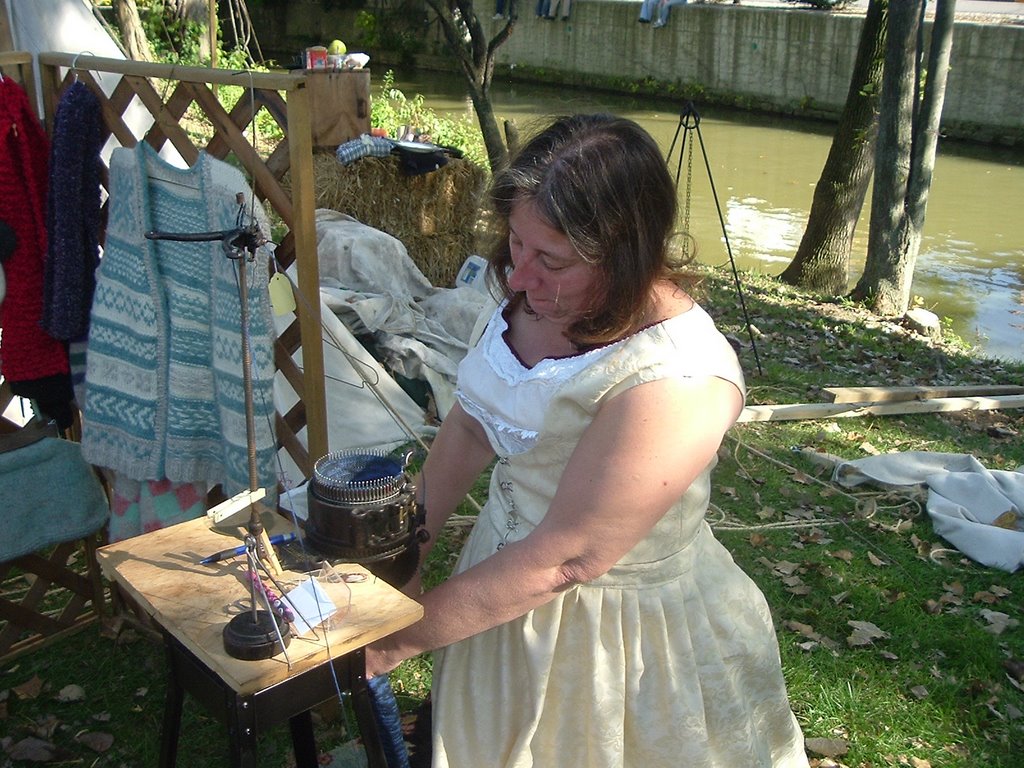 The antique knitting machine that was used to make my socks. Applebutter festival, Grand Rapids, Ohio. Behind the artisan is the canal. In the old days, barges were pulled along the canal by mules, walking the towpath trail. Now, the towpath trail is a hiking trail. It's one of our favorite places to walk. The festival takes place on the banks of the Maumee River.
Allen and I try to go to the Applebutter Festival in Grand Rapids, Ohio each year. I remember we used to take our boys to this festival with us when they were little. There are all sorts of sputtering antique engines, crafts, and, our favorite, the historical reinactments. Every so often, cannons fire over the river, giving everyone a start. The main menu items are bratwurst and saurkraut. This year, I bought a pair of socks that had been made on an unusual antique knitting machine, used during civil war days.
It's past midnight now, and the events of the day are mixing with old memories. I just now read this poem by James Wright:
Trying to Pray
This time, I have left my body behind me, crying
In its dark thorns.
Still,
There are good things in this world.
It is dusk.
It is the good darkness
Of women's hands that touch loaves.
The spirit of a tree begins to move.
I touch leaves.
I close my eyes and think of water.
Tuesday, September 12, 2006
Expanding the reach of who you are
Tonight I watched Faith and Doubt at Ground Zero on PBS for the second time. The first time I saw it was several months ago. It's a powerful exploration of how people's belief in God changed after 9/11. Kirk Varnedoe, the former director of the Museum of Modern Art, had the following to say about art and religion:
People say art is a substitute religion, and I thought about a lot about that in the aftermath of 9/11. It's true that art transports you, that it gives you the sense that you can find other worlds than the ones that you know are inside of you. There are so many imagined worlds. Each artist creates a world with its own logic and its own set of rules in which you can move in and inhabit. They find form that lets you imaginatively take part in experiences with which you may not have had any contact, and for a moment, conceive of a world as pearlescent and as beautifully, rectilinearly ordered as a Piero. To feel these things through art expands the reach of who you are.
But art doesn't only transport you to new, imagined places. It also, in the best sense, narrows your vision, focuses with a new immediacy on the things that may be the most familiar to you. It gives a new spiritual dimension to the objects that you touch, to the room that you inhabit. And this is not just a tidy or comfortable experience but can be suffused with a kind Dionysian pleasure, in the sense of the small world controlled and the poetry of the world possessed, this crossing over of the line between what is the love of the material thing, of the dust mote in the sunlight or the sheen of the porcelain, of the look of the ivy winding around the bowl of fish, you know, this sort of pleasure in the daily small things. In art, through art, I think, transmutes itself into a form of spirituality, one to which I respond very, very strongly. --KIRK VARNEDOE, former directer of MoMA
I believe this transport was also experienced by van Gogh. In his letters he speaks so much about the power of color to transport him; he had a special affinity for yellow. Van Gogh's experience with art is particularly intriguing, since he once wanted to go into the ministry. Can it be that art became his religion?
The poets Dickey, Roethke, and James Wright spoke of poetry transporting them. Dickey described being on a city street with Wright and Robert Bly and sinking to his knees in awe of poetry. I've read many of James Wright's letters, in which he speaks of reading, or writing, a poem and of transcending the ordinary. James Agee, who also wrote poetry, but who is mostly known for his prose works, like Death in the Family, also wrote of how his struggle with art led him to ephiphany.
In my own case, I feel a sense of rightness and connectedness when the writing is going well. It's as though the neurons in my brain are firing in just the right pattern, allowing me to experience many things at once, and through this explosive integration, I'm able to see the "truth." (In a recent Sun article, the author says scientists have actually observed this phenomenon in the brain.) Joseph Campbell called this a "peak" moment, and he connected it with the transcendent. When I reach this point while writing, it feels similar to moments I used to have in church back in the late 1970s when I felt a sudden rush of love.
I have to think about whether I agree that art is a "substitute" religion. Vernedoe doesn't say whether or not he agrees, but he does say that we can experience a form of spirituality through art. I do really like what Varnedoe says about what art does, that it expands the imagination and at the same time it narrows your vision. It gives you a chance to focus on very specific things so that you can see how sacred they are. At the same time, it opens you to mystery. Yes, I really like that explanation.
People say art is a substitute religion, and I thought about a lot about that in the aftermath of 9/11. It's true that art transports you, that it gives you the sense that you can find other worlds than the ones that you know are inside of you. There are so many imagined worlds. Each artist creates a world with its own logic and its own set of rules in which you can move in and inhabit. They find form that lets you imaginatively take part in experiences with which you may not have had any contact, and for a moment, conceive of a world as pearlescent and as beautifully, rectilinearly ordered as a Piero. To feel these things through art expands the reach of who you are.
But art doesn't only transport you to new, imagined places. It also, in the best sense, narrows your vision, focuses with a new immediacy on the things that may be the most familiar to you. It gives a new spiritual dimension to the objects that you touch, to the room that you inhabit. And this is not just a tidy or comfortable experience but can be suffused with a kind Dionysian pleasure, in the sense of the small world controlled and the poetry of the world possessed, this crossing over of the line between what is the love of the material thing, of the dust mote in the sunlight or the sheen of the porcelain, of the look of the ivy winding around the bowl of fish, you know, this sort of pleasure in the daily small things. In art, through art, I think, transmutes itself into a form of spirituality, one to which I respond very, very strongly. --KIRK VARNEDOE, former directer of MoMA
I believe this transport was also experienced by van Gogh. In his letters he speaks so much about the power of color to transport him; he had a special affinity for yellow. Van Gogh's experience with art is particularly intriguing, since he once wanted to go into the ministry. Can it be that art became his religion?
The poets Dickey, Roethke, and James Wright spoke of poetry transporting them. Dickey described being on a city street with Wright and Robert Bly and sinking to his knees in awe of poetry. I've read many of James Wright's letters, in which he speaks of reading, or writing, a poem and of transcending the ordinary. James Agee, who also wrote poetry, but who is mostly known for his prose works, like Death in the Family, also wrote of how his struggle with art led him to ephiphany.
In my own case, I feel a sense of rightness and connectedness when the writing is going well. It's as though the neurons in my brain are firing in just the right pattern, allowing me to experience many things at once, and through this explosive integration, I'm able to see the "truth." (In a recent Sun article, the author says scientists have actually observed this phenomenon in the brain.) Joseph Campbell called this a "peak" moment, and he connected it with the transcendent. When I reach this point while writing, it feels similar to moments I used to have in church back in the late 1970s when I felt a sudden rush of love.
I have to think about whether I agree that art is a "substitute" religion. Vernedoe doesn't say whether or not he agrees, but he does say that we can experience a form of spirituality through art. I do really like what Varnedoe says about what art does, that it expands the imagination and at the same time it narrows your vision. It gives you a chance to focus on very specific things so that you can see how sacred they are. At the same time, it opens you to mystery. Yes, I really like that explanation.
Subscribe to:
Posts (Atom)
Subscribe To


 Posts
All Comments
Posts
All Comments
Dreaming
About Me
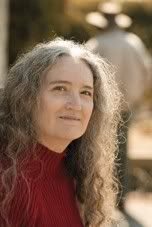
- Theresa Williams
- Northwest Ohio, United States
- "I was no better than dust, yet you cannot replace me. . . Take the soft dust in your hand--does it stir: does it sing? Has it lips and a heart? Does it open its eyes to the sun? Does it run, does it dream, does it burn with a secret, or tremble In terror of death? Or ache with tremendous decisions?. . ." --Conrad Aiken
Facebook Badge

Subscribe
Posts
All Comments
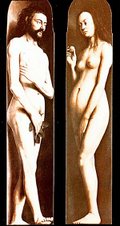
Fave Painting: Eden
Fave Painting: The Three Ages of Man and Death
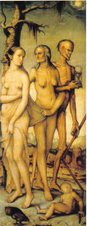
by Albrecht Dürer
My Original Artwork: Triptych
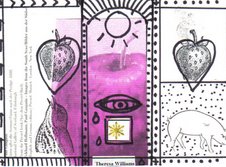
Wishing
Little Deer
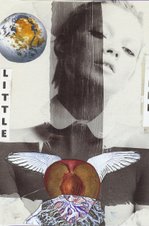
Transformation
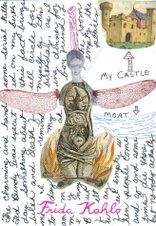
Looking Forward, Looking Back