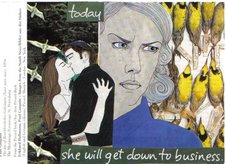
by Jack Kornfield:
There are no holy places and no holy people, only holy moments, only moments of wisdom.
Saturday, September 27, 2008


Wednesday, September 24, 2008
from Buddha's Little Instruction Book
by Jack Kornfield:
Do not judge yourself harshly. Without mercy for ourselves we cannot love the world.
Do not judge yourself harshly. Without mercy for ourselves we cannot love the world.
Sunday, September 21, 2008
Flying
I had a flying dream last night. I hadn't had one of those in a long while.
I think the dream was instigated by watching Peter and the Wolf on PBS last night. In the tale, a delightful little bird has trouble flying and Peter ties a helium balloon around its breast. The bird hopped, bounced, and sometimes soared. That is exactly what my flying dreams are like: I hop and bounce like I'm attached to a balloon that isn't quite large enough to get me off the ground. But after a few false starts, I soar. Sometimes I just float; other times, like in last night's dream, I hold my arms out like airplane wings.
In last night's dream, the air was filled with people flying.
I think the dream was instigated by watching Peter and the Wolf on PBS last night. In the tale, a delightful little bird has trouble flying and Peter ties a helium balloon around its breast. The bird hopped, bounced, and sometimes soared. That is exactly what my flying dreams are like: I hop and bounce like I'm attached to a balloon that isn't quite large enough to get me off the ground. But after a few false starts, I soar. Sometimes I just float; other times, like in last night's dream, I hold my arms out like airplane wings.
In last night's dream, the air was filled with people flying.
Saturday, September 20, 2008
Starting from the Lowest Possible Place
"I must lie down where all the ladders start," wrote Yeats in The Circus Animals' Desertion, "In the foul rag and bone shop of the heart."
This poem, one of his last, shows a poet searching for inspiration. The speaker concludes it may be found not in the beauty of the heart's core but within "a mound of refuse or the sweepings of a street, / Old kettles, old bottles, and a broken can, / Old iron, old bones, old rags ..."
In this stanza, Yeats reveals an important life truth. It is one he has explored before; In his poem, The Coming of Wisdom with Time, Yeats wrote that "leaves are many" but "the root is one." As a youth, the speaker "swayed my leaves and flowers in the sun" but now says it may be time to "wither into the truth." No matter how showy the leaves, the root that taps the earth for water and nourishment is the true place. It is also a dark place.
In both poems, Yeats rejects the romanticism of his earlier work. As he wrote in a letter to Lady Gregory: "We must accept the baptism of the gutter." The human condition need not be transcended if one learns to accept it with gusto.
Years later, the poet Theodore Roethke would also recognize that his most masterful poetry came from a primal place. Roethke, like Yeats, wanted to achieve human sanctity. In Roethke's mature work, inspiration often came from the most lowly of places, such as when he wrote of the worm climbing up the winding stair. Nature might also be menacing as in his poem Orchids:
They lean over the path,
Adder-mouthed,
Swaying close to the face,
Coming out, soft and deceptive,
Limp and damp, delicate as a young bird's tongue;
Their fluttery fledgling lips
Move slowly,
Drawing in the warm air.
In the second stanza, the orchids are described as "So many devouring infants" with "Lips neither dead nor alive" and "Loose ghostly mouths / Breathing."
Yeats's baptism of the gutter is made real in Roethke's poem Cuttings (later):
This urge, wrestle, resurrection of dry sticks,
Cut stems struggling to put down feet,
What saint strained so much,
Rose on such lopped limbs to a new life?
I can hear, underground, that sucking and sobbing,
In my veins, in my bones I feel it, --
The small waters seeping upward,
The tight grains parting at last.
When sprouts break out,
Slippery as fish,
I quail, lean to beginnings, sheath-wet.
The second stanza is lusty. It mirrors Yeats's thought that if we can accept the limitations of life boldly, we will find inspiration aplenty. Yeats said that such acceptance allows us to come into our "force."
We come into our strength as artists and as people when we quit trying to transform ugliness into beauty. Ugliness is what it is. Learn to live with it. Lift it up. Study and reveal it. Let it give you life, just as beauty does.
This poem, one of his last, shows a poet searching for inspiration. The speaker concludes it may be found not in the beauty of the heart's core but within "a mound of refuse or the sweepings of a street, / Old kettles, old bottles, and a broken can, / Old iron, old bones, old rags ..."
In this stanza, Yeats reveals an important life truth. It is one he has explored before; In his poem, The Coming of Wisdom with Time, Yeats wrote that "leaves are many" but "the root is one." As a youth, the speaker "swayed my leaves and flowers in the sun" but now says it may be time to "wither into the truth." No matter how showy the leaves, the root that taps the earth for water and nourishment is the true place. It is also a dark place.
In both poems, Yeats rejects the romanticism of his earlier work. As he wrote in a letter to Lady Gregory: "We must accept the baptism of the gutter." The human condition need not be transcended if one learns to accept it with gusto.
Years later, the poet Theodore Roethke would also recognize that his most masterful poetry came from a primal place. Roethke, like Yeats, wanted to achieve human sanctity. In Roethke's mature work, inspiration often came from the most lowly of places, such as when he wrote of the worm climbing up the winding stair. Nature might also be menacing as in his poem Orchids:
They lean over the path,
Adder-mouthed,
Swaying close to the face,
Coming out, soft and deceptive,
Limp and damp, delicate as a young bird's tongue;
Their fluttery fledgling lips
Move slowly,
Drawing in the warm air.
In the second stanza, the orchids are described as "So many devouring infants" with "Lips neither dead nor alive" and "Loose ghostly mouths / Breathing."
Yeats's baptism of the gutter is made real in Roethke's poem Cuttings (later):
This urge, wrestle, resurrection of dry sticks,
Cut stems struggling to put down feet,
What saint strained so much,
Rose on such lopped limbs to a new life?
I can hear, underground, that sucking and sobbing,
In my veins, in my bones I feel it, --
The small waters seeping upward,
The tight grains parting at last.
When sprouts break out,
Slippery as fish,
I quail, lean to beginnings, sheath-wet.
The second stanza is lusty. It mirrors Yeats's thought that if we can accept the limitations of life boldly, we will find inspiration aplenty. Yeats said that such acceptance allows us to come into our "force."
We come into our strength as artists and as people when we quit trying to transform ugliness into beauty. Ugliness is what it is. Learn to live with it. Lift it up. Study and reveal it. Let it give you life, just as beauty does.
Monday, September 15, 2008
"The Self-Unseeing"
"The Self-Unseeing" is a poem by Thomas Hardy (1840-1928). Tomorrow in Modern Poetry, we are going to take a look at a couple of Hardy's poems, but not "The Self-Unseeing"--it just didn't make it into the syllabus this time around.
"The Self-Unseeing" is about transience and how this transience haunts moments of happiness.
The Self-Unseeing
Here is the ancient floor,
Footworn and hollowed and thin,
Here was the former door
Where the dead feet walked in.
She sat here in her chair,
Smiling into the fire;
He who played stood there,
Bowing it higher and higher.
Childlike, I danced in a dream;
Blessings emblazoned that day;
Everything glowed with a gleam;
Yet we were looking away!
The speaker remembers a moment of profound blessing which was, at the time, unappreciated.
Is the poem a reminder to live in the moment, to count one's blessings as they occur?
I don't think so. Hardy's speaker seems to believe that, because we cannot know the future or imagine ourselves in a future time, we can never fully understand our blessings as they occur. Full understanding comes only afterwards and when it is too late. Thus life is sad and full of regret. That is just the way things are.
While things glow and gleam, we are looking away.
"The Self-Unseeing" is about transience and how this transience haunts moments of happiness.
The Self-Unseeing
Here is the ancient floor,
Footworn and hollowed and thin,
Here was the former door
Where the dead feet walked in.
She sat here in her chair,
Smiling into the fire;
He who played stood there,
Bowing it higher and higher.
Childlike, I danced in a dream;
Blessings emblazoned that day;
Everything glowed with a gleam;
Yet we were looking away!
The speaker remembers a moment of profound blessing which was, at the time, unappreciated.
Is the poem a reminder to live in the moment, to count one's blessings as they occur?
I don't think so. Hardy's speaker seems to believe that, because we cannot know the future or imagine ourselves in a future time, we can never fully understand our blessings as they occur. Full understanding comes only afterwards and when it is too late. Thus life is sad and full of regret. That is just the way things are.
While things glow and gleam, we are looking away.
Subscribe to:
Posts (Atom)
Subscribe To


 Posts
All Comments
Posts
All Comments
Dreaming
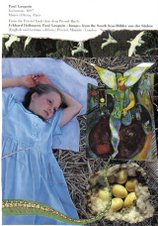
About Me
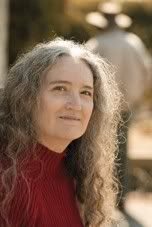
- Theresa Williams
- Northwest Ohio, United States
- "I was no better than dust, yet you cannot replace me. . . Take the soft dust in your hand--does it stir: does it sing? Has it lips and a heart? Does it open its eyes to the sun? Does it run, does it dream, does it burn with a secret, or tremble In terror of death? Or ache with tremendous decisions?. . ." --Conrad Aiken
Facebook Badge

Subscribe
Posts
All Comments
Fave Painting: Eden
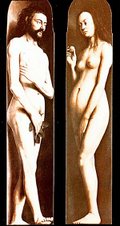
Fave Painting: The Three Ages of Man and Death
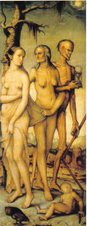
by Albrecht Dürer
My Original Artwork: Triptych
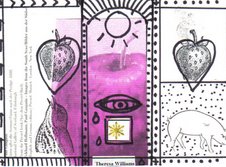
Wishing
Little Deer
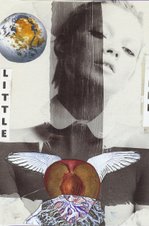
Transformation
Looking Forward, Looking Back