Tonight I watched Faith and Doubt at Ground Zero on PBS for the second time. The first time I saw it was several months ago. It's a powerful exploration of how people's belief in God changed after 9/11. Kirk Varnedoe, the former director of the Museum of Modern Art, had the following to say about art and religion:
People say art is a substitute religion, and I thought about a lot about that in the aftermath of 9/11. It's true that art transports you, that it gives you the sense that you can find other worlds than the ones that you know are inside of you. There are so many imagined worlds. Each artist creates a world with its own logic and its own set of rules in which you can move in and inhabit. They find form that lets you imaginatively take part in experiences with which you may not have had any contact, and for a moment, conceive of a world as pearlescent and as beautifully, rectilinearly ordered as a Piero. To feel these things through art expands the reach of who you are.
But art doesn't only transport you to new, imagined places. It also, in the best sense, narrows your vision, focuses with a new immediacy on the things that may be the most familiar to you. It gives a new spiritual dimension to the objects that you touch, to the room that you inhabit. And this is not just a tidy or comfortable experience but can be suffused with a kind Dionysian pleasure, in the sense of the small world controlled and the poetry of the world possessed, this crossing over of the line between what is the love of the material thing, of the dust mote in the sunlight or the sheen of the porcelain, of the look of the ivy winding around the bowl of fish, you know, this sort of pleasure in the daily small things. In art, through art, I think, transmutes itself into a form of spirituality, one to which I respond very, very strongly. --KIRK VARNEDOE, former directer of MoMA
I believe this transport was also experienced by van Gogh. In his letters he speaks so much about the power of color to transport him; he had a special affinity for yellow. Van Gogh's experience with art is particularly intriguing, since he once wanted to go into the ministry. Can it be that art became his religion?
The poets Dickey, Roethke, and James Wright spoke of poetry transporting them. Dickey described being on a city street with Wright and Robert Bly and sinking to his knees in awe of poetry. I've read many of James Wright's letters, in which he speaks of reading, or writing, a poem and of transcending the ordinary. James Agee, who also wrote poetry, but who is mostly known for his prose works, like Death in the Family, also wrote of how his struggle with art led him to ephiphany.
In my own case, I feel a sense of rightness and connectedness when the writing is going well. It's as though the neurons in my brain are firing in just the right pattern, allowing me to experience many things at once, and through this explosive integration, I'm able to see the "truth." (In a recent Sun article, the author says scientists have actually observed this phenomenon in the brain.) Joseph Campbell called this a "peak" moment, and he connected it with the transcendent. When I reach this point while writing, it feels similar to moments I used to have in church back in the late 1970s when I felt a sudden rush of love.
I have to think about whether I agree that art is a "substitute" religion. Vernedoe doesn't say whether or not he agrees, but he does say that we can experience a form of spirituality through art. I do really like what Varnedoe says about what art does, that it expands the imagination and at the same time it narrows your vision. It gives you a chance to focus on very specific things so that you can see how sacred they are. At the same time, it opens you to mystery. Yes, I really like that explanation.
Showing posts with label James Dickey. Show all posts
Showing posts with label James Dickey. Show all posts
Tuesday, September 12, 2006


Wednesday, April 12, 2006
To Feel Alive
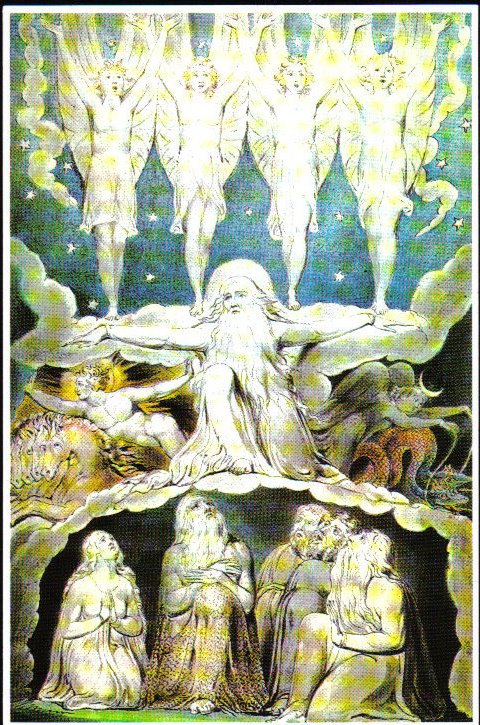
Artist: William Blake.
Capote, to his editor, Robert Linscott, in 1947:
"I am working on the book and it is really my love and today I wrote two pages and oh Bob I do want it to be a beautiful book because it seems important to me that people try to write beautifully, now more than ever because the world is so crazy and only art is sane and it has been proven time after time that after the ruins of a civilization are cleared away all that remains are the poems, the paintings, the sculpture, the books."
Why is it that I so rarely show this kind of enthusiasm in my blog about writing? Why do I so often over-organize my thoughts and over-analyze the writing process?
I think I'm afraid people will think I'm a "flake" if I show too much enthusiasm.
Yet I don't think Capote is a flake when he writes, "...and oh, ... I do want it to be a beautiful book ... only art is sane." Nor was Dickey a flake when he described being so overtaken by the beauty of the writing process that he fell down to his knees in the middle of the street, felled by the power of that feeling.
I watched a documentary on PBS tonight, on Independent Lens. It was about John Trudell, a Native American activist, poet, and songwriter, whose wife and children died when their house was burned as a result of political unrest on the reservation, violence instigated by the US Government. You may know him from the movies. Trudell was in Thunderheart, and other films.
But, for Trudell, it isn't about being a "star." At the end of the documentary, he says something to the effect that he feels the purpose of his life is share his poems and his stories. He knows he is only one man and he isn't singlehandedly going to change the system.
He just wants to be a part of the exchange of information, of thought. He does this through writing because writing gives him a sense of of what it is to be alive. I think this was so for William Blake. He was animated through his art.
That is what I want, too, to feel alive by creating.
Saturday, February 18, 2006
The Poet-Seer: In Defense of Dickey
"Remember: our life does not turn on trivialities, but on the stars."
My, I can see I unleashed a little firestorm with my last post on James Dickey. A debate has arisen concerning Dickey's view of the poet's status in the universe. Does Dickey think he's superior to others, or not?
First, I think I may have done Dickey a disservice, posting that speech without providing relevant commentary. I'd like to provide some now, although I will admit, I'm dealing with some pretty heavy material in my studies of Agee, Wright, Bly and Dickey, some big thoughts that I haven't managed to completely wrap my mind around yet. Which is probably why I didn't include commentary on the Dickey speech in the previous post: I hadn't absorbed it yet. In other words, without being quite aware of what I was doing, I was posting Dickey's words so I could truly see them and reflect on them. I hadn't considered they could actually offend my readers' sensibilities.
Second, I think it's important to reveal at this time that I came to Dickey through reading James Wright's letters. Some of you recall that I took a river journey this past summer which lasted two months. One of the stops on the journey was Martins Ferry, Ohio, where Wright was born. I took Wright's collection of poems with me on the trip and bought Wright's letters when I returned home, after seeing the letters reviewed in The New Yorker. Wright's and Dickey's correspondence intrigued me. I was impressed at the volume of the letters they produced and at the quality of thought in them. I recently found the collection of Dickey's letters on Amazon and have just started reading them.
Third, Dickey's letters come to me at a time when I've been searching for what it means to be an artist. Those of you who have been following my blog know that I've been wrestling with my thoughts on writing and the creative life the whole time I've been blogging. I'd been wrestling with these thoughts much longer than that. At least now I've decided that I am indeed "an author," but what does that mean? What is the artist's relationship to the world? To understand the role of the artist, I've been avidly reading what artists have had to say on the matter.
My point of intersection with Dickey is in how he viewed the poet's work as a divine act. In my reading of Wright, Dickey, Bly, and Agee, I've come to understand they were very serious about their art. Wright, Dickey, and Agee were troubled men. They all drank heavily and suffered all manner of depression, alienation, and heartache. I don't think it would be exaggerating to say it was poetry that gave these men the only sense of freedom they had ever known. They were not religious in the conventional sense, but they felt the divine through their art. It's frankly quite amazing to me that I could have anything in common with these hard-living, driven men. I once thought my attitude of art's connection to the divine was feminine or soft. Seeing the attitude expressed through a strong male figure like Dickey shows me my thinking was wrong.
For these men, the poetic consciousness gave them a faculty through which to perceive the spiritual world. It gave them, they thought, an inkling into a world of "Divine Wisdom"--the world of the Sophia. Their work looked into the darkness, and, like Novalis, they saw in this darkness the great mystery of life. Their art was their way of overcoming death because through their art, they believed they had tapped into something eternal.
Novalis was a German poet living at the end of the 1700s. He had a spiritual vision at the grave of the woman he was to marry, and in this vision he came to understand the value of darkness and the mystery of life. Novalis wrote:
...then, out of the blue distances, from the hills of my ancient bliss, came a shiver of twilight, and at once snapt the bond of birth, the fetter of the Light. Away fled the glory of the world, and with it my mourning; the sadness flowed together into a new, unfathomable world.
I think Dickey, Wright, Bly, and Agee also had this vision. They may have experienced it in a different way than Novalis did, but their insights were hard won through a series of falls, sufferings, and finally a kind of resurrection through their art. Certainly, Dickey and the others were drawn to poets like Novalis, de Nerval, Neruda, Trakl, and Vallejo, poets who had entered this darkness either through suffering or madness, sometimes both.
This, I think, is what Dickey means when he says the poet is elevated. This poet-seer, through art, has access to the great mysteries of life, what Dickey refers to as "the secret." It's this mystery that Dickey elevates above the trivialities of culture, the schlock culture, along with its "general icons." It may help to know that Dickey worked in advertising for a while in order to pay the bills. In one letter, in fact, he draws a distinction between a Coca Cola ad he was working on and Shakespeare. Coca Cola is a general icon. Coca Cola is schlock. It isn't on the same plane as Shakespeare, or de Nerval, or Novalis. Coca Cola is not divine, in Dickey's view.
"Away fled the glory of the world," Novalis wrote. In other words, Novalis had seen "the secret" and nothing could compare.
To further illustrate what Dickey may have meant by poets being "up there" and general icons being "down there," consider something that Wright wrote to Robert Bly: "You know, I sometimes try to escape the thought, but it returns and returns and returns: that some day I shall rise at morning and simply walk outside and away, leaving everything behind, like Buddha. Yes, I shall be killed by a runaway checkbook or an insane life-insurance policy by the time I get two blocks from home."
I speak of Wright, Bly, and Dickey almost interchangeably because they were poets during the same time and were great friends who corresponded about art over a long period. They helped sharpen each other's thoughts. Wright made the comment about Buddha and life-insurance, but Dickey could just as well have. The runaway checkbook and the insane life-insurance policy are those killing forces Dickey was talking about. They are "down there," that is, trivial considerations compared to "the secret."
In Dickey's own work, his poetry and his fiction, we see a that mystery being played out through encounters with nature. Deliverance is the example most people will remember. In that novel, the river is a force that humans seek to "beat" or to "control." But Dickey believed the mystery could not be controlled, and only those who didn't understand the mystery sought to control it. Humans try to put themselves above the mystery, or "the secret."
At the beginning of this post, I included a quote from one of Wright's letters, a letter he wrote to a despairing friend. Wright and Dickey wrote many such letters to poet friends, letters of encouragement.
Wright wrote to his friend: "Remember: our life does not turn on trivialities, but on the stars."
I think this is what Dickey was saying.
There's poetry in everything. A poem isn't just a series of words, lines, or stanzas on paper. The river is poetry; a potato is poetry. A tree, a rock, the sky, a crow, a mermaid, the turkey shit my mother used to spread on her garden (which, by the way, she said was "like gold.") If you could read Dickey's letters, and Wright's, I think you'd see the absolute humility they had when it came to their role as artists. They were in complete awe of poetry and felt their inadequacies acutely.
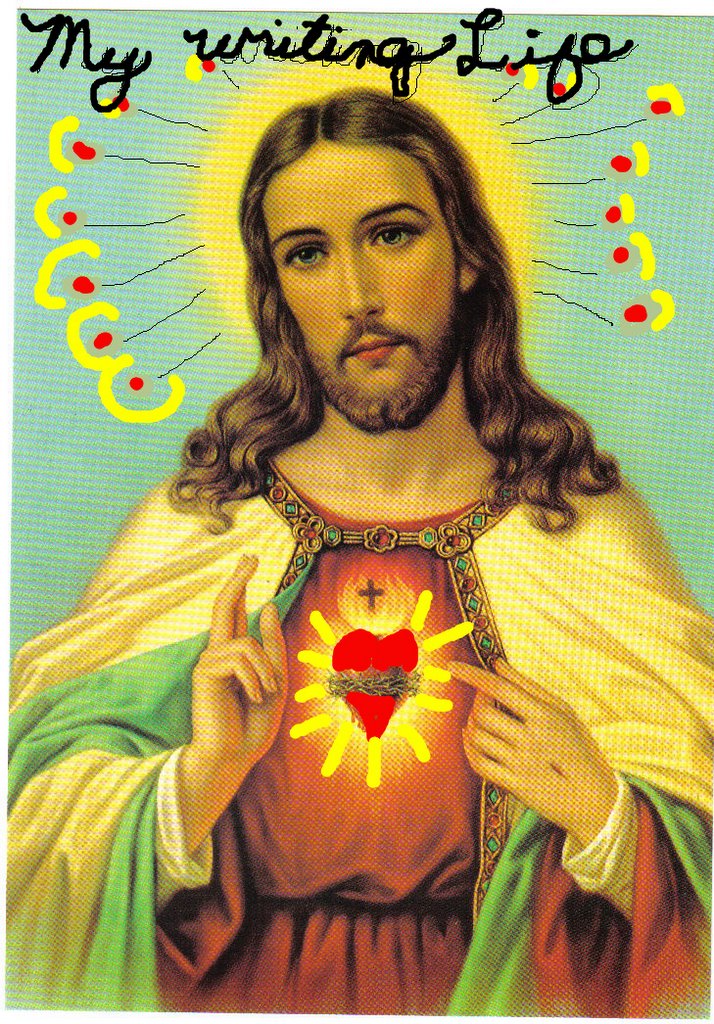
I hope I've clarified a few things for my wonderful friends and readers. Like I said, I've only begun to scratch the surface of these mysteries myself. The picture of Jesus is one I've posted before, back on my AOL blog. It was posted on one of the first entries I did. When I posted that picture of Jesus so long ago and called it "My Writing Life," I had only the vaguest notion of what the implications of that picture were. I think I'm getting closer to understanding what "My Writing Life" does indeed mean. Bear with me as I continue my search.
Tuesday, February 14, 2006
The Value of Poetry
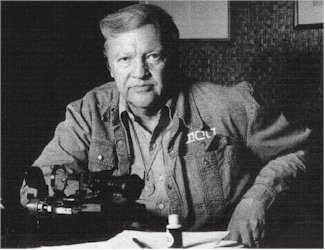
Today, after teaching, I delved into a book that just arrived in mailbox today, a book of James Dickey's letters. The book is called Crux, after the title of the book Dickey was working on when he died. (Many people will remember Dickey as the novelist who wrote Deliverance.)
In the Introduction to the Dickey letters, the editor, Matthew J. Bruccoli reveals the last words Dickey spoke to his poetry composition students before he died, just two days later. I want to reproduce Dickey's last words to his students because I need to type them out. When I type passages out, they become a part of me. And I think some of my friends in the blogging world will be moved by Dickey's words. So many of us are striving to give ourselves to our creative lives. It's wonderful, then, to read the words of someone like Dickey, who loved poetry as he loved life. (I think you can use "poetry" interchangeably with any artistic endeavor, any act of creation).
In reading the following passage tonight, I was struck by how similar my thoughts are to Dickey's. I have discussed in my blog many times how I think art and religion are the same for me. Dickey also thought the creative life was connected somehow to God. He said the following life-affirming things even as he knew he did not have long to live. So one of the last things he talked about was the importance of poetry. Here is what he said:
When we get started, I want you to fight this thing through. Fight the thing through that we start with your own unconscious and your own dreams and see where it comes out. That's the excitement and the fun of it. Deep discovery, deep adventure. It's the most dangerous game and the best.
Flaubert says somewhere that "The life of a poet is a hell of a life. It's a dog's life. But it's the only one worth living." You suffer more, you're frustrated more. All the things that don't bother other people. But you also live so much more. You live so much more intensely and so much more vitally and with so much more of a sense of meaning of consequentiality. Of things mattering instead of nothing mattering.
This is what's driving our whole civilization into suicide. The fear that we are living an existence in which nothing matters very much or at all. ...A sense of non-consequence, a sense of nothing, nothing matters. No matter which way we turn it's the same thing. The poet is free of that. He's free of it.
To the poet everything matters, and it matters a lot, and that's the realm where we work and once you're there you are hooked. If you're a real poet you're hooked more deeply than any narcotics addict could possibly be hooked on heroin. You're hooked on something that is life-giving instead of destructive. Something that is a process which cannot be too far from the process that created everything. God's process. ...
What this universe indubitably is is a poet's universe. Nothing but a poetic kind of consciousness could have conceived of anything like this. That's where the truth of the matter lies. You are in some way in line with the creative genesis of the universe in some way, in a much lesser way of course, because we can't create those trees or that water or anything that's out there. We can't do it but we can recreate it. We are secondary creators.
We take God's universe and we make it over our way and it's different from his. It's similar in some ways, but it's different in some ways. The difference lies in the slant. The slant that we individually put on it and that only we can put on it. That's the difference and that's where our value lies. Not only for ourselves but for the other people who read us.
The other people who read us. There's some increment there that we make possible that would not otherwise be there. I don't mean to sell the poet so long or to such great length, but I do this principally because the world doesn't esteem the poet very much. They don't really understand where we're coming from. They don't understand the use for us or if there is any use. They don't really value us very much. We are the masters of a superior secret, not they. Not they. Remember that when you write. You are at the top level and they are down there with ... the general idols of the schlock culture we live in. ...
My grandmother was born in Germany and she used to quote from Goethe a lot and one of her favorite sayings was, "Whoever strives upward, him we can save." ...we must find some way to write as though our hands were the hands of someone miraculously superior to ourselves. This is what we aim for.
So when you begin to say things you didn't know you knew or you never had any idea you had any notion that you knew, then maybe you're getting somewhere you should be as a poet. Not invariably, but it's possible under those conditions. It's possible. ...
Thursday, February 02, 2006
Growth and Change
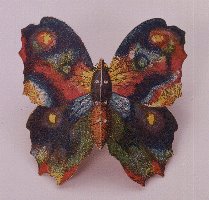
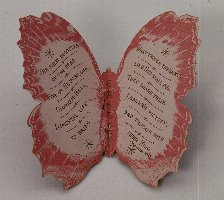 A butterfly created by Walt Whitman ~~~~~~~~~~~~~~~~~~~~~~~~~~~~~~~~~~~~~~~~~~~~~~~~
I recently mentioned something in one of my posts about my writing going through a change. I believe when I said "change" I left the impression that my writing was going through a period of positive change and growth. I hope this is true, but I might possibly be moving toward a dead-end, too. After I made that post, I found the following quote by James Dickey, who wrote Deliverance and who was also a very fine poet. The quote made me think about "change" versus "growth." I know there have been many times when I've tried something new and it didn't work out. I've chalked it up as a failure. Writers are hard on themselves like that. However, I like the way Dickey thinks. I think I'll adopt this attitude from now on:
When you've published as much as I have, and you get to be my age, there are going to be people who want you to do what they are familiar with. They inevitably say, "He's slipping, he's not as good as he used to be," or "His early work was much better" ... But I don't really care about being as good as, or not as good as, or better than...My primary consideration is to change. I dare not use the word grow; there may or may not be growth, but to change. To still keep that openness, that chance taking-ness as part of the work. Not to be afraid to make a mistake, even if it's a long and costly mistake. --James Dickey in Night Hurdling, his book of essays and interviews, published in 1983.
Subscribe to:
Posts (Atom)
Subscribe To


 Posts
All Comments
Posts
All Comments
Dreaming
About Me
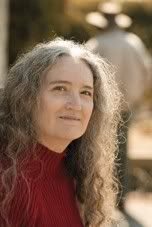
- Theresa Williams
- Northwest Ohio, United States
- "I was no better than dust, yet you cannot replace me. . . Take the soft dust in your hand--does it stir: does it sing? Has it lips and a heart? Does it open its eyes to the sun? Does it run, does it dream, does it burn with a secret, or tremble In terror of death? Or ache with tremendous decisions?. . ." --Conrad Aiken
Facebook Badge

Subscribe
Posts
All Comments
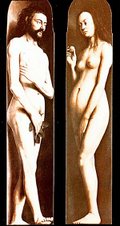
Fave Painting: Eden
Fave Painting: The Three Ages of Man and Death
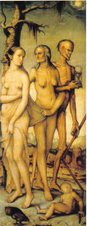
by Albrecht Dürer
My Original Artwork: Triptych
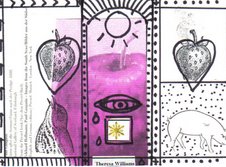
Wishing
Little Deer
Transformation
Looking Forward, Looking Back