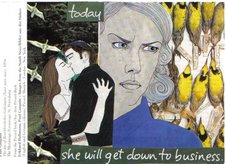
I was reading an interview with Ursula K. LeGuin about her new rendition of the Tao Te Ching. Her version does more to stress feminine power. During the interview, LeGuin refers to a passage where Lao Tzu says we should be like nature, although nature isn't humane. That means Lao Tzu is saying self-sacrifice is not a good thing, but, in LeGuin's words, a "lousy thing."
I was intrigued by this because I've always felt drawn to self-sacrifice. It's often where I derive meaning for myself. LeGuin does help me to see self-sacrifice in a new light; well, perhaps not new, because I have thought about the nature of sacrifice before and wondered about its dark side. Says LeGuin:
Nature is definitely not humane. And Lao Tzu says we should be like nature. We should not be humane, either, in the sense that we should not sacrifice ourselves for others. Now that's going to be very hard for Christian readers to accept, because they're taught that self-sacrifice is a good thing. Lao Tzu says it's a lousy thing. This is perhaps the most radical thing he says to a Western ear. Don't buy into self-sacrifice. Any more than you would ask somebody to sacrifice themselves for you. There's a sort of reciprocity--that's the only way I can understand it.
I've been thinking about this since Mother Teresa's recent death. I have never been comfortable with her or with any extreme altruism. It makes me feel inferior, like I ought to be like that, but I'm not. And if I tried to be, it would be the most horrible hypocrisy. But why, what is it that I'm uncomfortable with? And I think maybe Lao Tzu gives me a little handle on that. In a sense, this kind of self-sacrifice occurs only in a society that is so sick that only somebody going too far can make up for the cruelty of the society.
This is startling to me. I've just been reading Karen Armstrong, who goes through each religion and shows how sacrifice became a defining feature. If LeGuin is right, then Lao Tzu's perception of religion is different from the others. It rests on reciprocity, not sacrifice.
Nature is beautiful and sometimes entertaining, but it isn't humane. This, it seems to me, is a truth that's become lost to us. Because we don't live with nature anymore, we've forgotten it's not a place of sacrifice, forgiveness, or grace. The recent deaths of Timothy Treadwell (Grizzly Man) and Steve Irwin (Crocodile Man) illustrate this. Both men have been criticized and blamed for their own deaths. Each man loved nature and sought to preserve it, but in also making it a form of sport and entertainment, they forgot reciprocity. Animals ought to be respected according to their natures, not turned into playthings or teddy bears. Both men forgot how we're connected to things. I believe we all suffer from the same blindness.
I recall an experience I had with the editors of The Sun magazine. They'd accepted a story of mine for publication and the story was going through the editing phase. I can't remember how I'd originally worded the sentence, but it was about give and take, getting something and giving something in return. It was about someone giving a gift on their own birthday, instead of just sitting back and receiving. The editors suggested the word "reciprocity." Looking at the word inserted into my own sentence by the editors, I rather gasped. What a beautiful word. That one word changed a simple idea into something clearly defined, and sacred.
But it isn't until right now, this moment, that I begin to think about what reciprocity means and how this concept might guide my life and my writing.
What if I didn't think of writing as an obligation or as a sacrifice I make by locking myself in a silent room for many hours. What if it is an act of reciprocity? Of giving back, of attempting to reveal some vision or insight I have been given?
Showing posts with label Tao. Show all posts
Showing posts with label Tao. Show all posts
Saturday, September 16, 2006


Saturday, April 15, 2006
Something Found
Today, I received an e-mail from a stranger who happened upon something I'd written in my old AOL Journal. Below is her note and also a copy of the original post. It is a rare and beautiful thing when a stranger reads and comments on your words. Have any of you experienced this? If so please share it with me:
Dear Ms. Williams,
I am writing to you after coming across a piece of your writing entitled "The One Thing I Would Most Like You to Know About Me" several weeks ago. My first reaction after reading it was almost disbelief. I thought I was reading an essay about me and I was so stunned I had to read it several times over. It seems you have captured everything I was thinking about but was able to put it in writing and provide an explanation, a resolution and for that I would like to thank you.
For the past year or two my life has been nothing less than confusing and a mindless journey towards something in the dark. After much reflection I believe I have found a somewhat clear path to travel upon, but at least I know I have an idea of where I'm going, so again, thank you for being a catalyst to this.
Now to my actual intention and reasoning for writing you today. I was so inspired by and connected to this essay I have decided to get something for myself that will always remind me of my own bitterness and also a reminder of what I am working towards.
Next Thursday I plan on getting a tattoo of the Chinese characters for 'bitter' and 'sweet'. Again, I must say thank you for providing the inspiration. I truly believe that tattoos have the power to heal and guide and that this one will be no different. I am still not quite sure why I feel the need to inform you of all of this. I suppose it might provide further closure and assurance of what I have discovered within myself from your work.
Have a wonderful Easter weekend!
Best Regards,
[She signed her name, but I will protect her anonymity]
~~~~~~~~~~~~~~~~~~~~~~~~~~~~~~~~~~~~~~~~~~~
The One Thing I Would Most Like You to Know About Me
I want you to know that I am bitter.
Does this seem like a negative thing to admit?
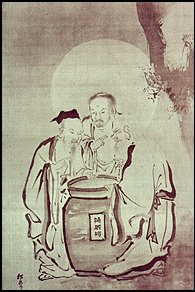
It's an observation that's related to a painting I recently became acquainted with, "The Vinegar Tasters."
In "The Vinegar Tasters," three men stand around a vat of vinegar. Each man has just tasted the vinegar and is having a reaction to it.
Vinegar, by the way, comes from a French word, vinaigre, meaning sour wine and has been used since ancient times. The Chinese saw great medicinal qualities in vinegar and called it the essence of life.
One man in the painting looks sour. He represents Confucius, who looked to tradition for meaning and order. Another man looks bitter. He represents Buddha. He represents me: I am bitter.
To Buddha, life is bitter. Life is full of attachments and desires that lead to suffering. Life is a revolving wheel of pain, which can be escaped by achieving Nirvana.
This sounds awful, I know. We all want to be happy. But bear with me, now.
For a long time, I tried to avoid my feelings of suffering. So I buried myself in intellectual pursuits. I set a series goals for myself, most of which I achieved.
These are some of the goals I set for myself: I will get this degree, I will get this award, I will get into this program, I will get this grade, I will be inducted into this society, I will be the best in the class, I will win this contest.
Many of my pursuits were in the arts. I studied studio art and creative writing. But I'm pretty sure that neither my art nor my writing really spoke to people. It certainly didn't speak to me. I was a scholarship girl.
A scholarship girl is a student who works hard and does all the "right" things, but doesn't know why she is doing them. She takes good notes, writes good papers, learns techniques, and even creates mildly exceptional works of art. And her teachers love her. She loves them, too. She lives for their applause.
I use "girl" instead of woman because in so many ways I wasn't fully grown.
The whole time, I was pretending I wasn't suffering. I was suffering, but I had pushed down my hurt. The details of my hurt aren't important. The hurt and the reasons for it are common enough, universal. All of us have hurt in the ways I was hurting. In a nutshell, I hurt because I had never learned to deal with loss or longing or grief. I hurt because I didn't know who I was. Tobias Wolff described my condition in his memoir, This Boy's Life. He said, "Because I did not know who
I was, any image of myself, no matter how grotesque, had power over me." Images of yourself aren't necessarily grotesque as in "ugly." A beautiful image of yourself, such as a scholarship girl, can feel grotesque if it doesn't feel true.
Inside, I was bitter, like Buddha is bitter in the picture. Outwardly, I smiled a lot.
The one thing I would most like you to know about me is that I was bitter then. And I want you to know that I'm bitter now. I'm no longer a scholarship girl (Although there are still many ways in which I'm not fully grown.)
The difference between the person I was then and the person I am now is that I'm learning to embrace my suffering, as one embraces a child. I'm not running away from my suffering by trying to find happiness in outside accomplishments or pursuits. I'm learning to cherish my suffering as one cherishes a child. Because out of my suffering comes my art.
The thing I want you to know about me is that I don't believe that this kind of bitterness is a bad thing. The Chinese character for suffering is "bitter," and Buddha said suffering is holy. It is holy because points us toward liberation. I think the Christ story teaches us the same thing. When Thomas touched Christ's wounds, Thomas looked deeply into those wounds, the wounds representing all suffering. Indeed, to look at any wound takes courage.
Now, when I write. I look deeply into my suffering, and it is sometimes a terrible place to go, but there's a liberation that happens afterwards. With that liberation comes a new energy. That energy feels a lot like joy.
I want you to know: I am bitter and that is okay.
A few years ago, I ran across a poem by Stephen Crane:
In the desert
I saw a creature, naked, bestial,
Who, squatting upon the ground,
Held his heart in his hands,
And ate of if. I said:
"Is it good, friend?"
"It is bitter-bitter," he answered;
"But I like it
Because it is bitter,
And because it is my heart."
I remember my own heart beating fast as I read this poem. The hairs went up on the back of neck and on my arms. Something about the poem felt very true. But for a long time I couldn't get past the negative connotations of "bestial" and "bitter."
Now, I see that the creature is bestial in the way we all are. We are animals, after all, beasts. We live according to the same natural laws as beasts. We have to kill to eat, and we have to eat to live. We are mad to couple, mad to survive.
The beast is bitter in the same way that I am bitter, I realize now. The beast is eating its bitter heart because that's where its suffering lives.
When I write, I'm a lot like the creature in Crane's poem, I think. When I write, I am naked and bestial. I am eating my bitter, bitter heart.
Which brings me to my final point:
Who is the third man in the painting of the "Vinegar Tasters"?
He is Lao-Tse. He is smiling. He has learned that life, even as painful as it sometimes is, is sweet.
Do I want someday to be the smiling one?
You bet.
I don't know what it will mean for my writing. But, yes, I want to be like him, like Lao-Tse.
I want you to know that I'm working on it.
Sunday, March 26, 2006
Negative Capability
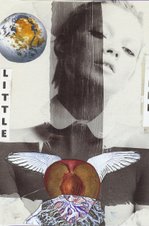
 My Collage: Little Deer: 03-26-06, based on Frida Kahlo's Little Deer (1946)
~~~~~~~~~~~~~~~~~~~~~~
This collage is based on one of my favorite Kahlo paintings, Little Deer. It's done on the back of a postcard bearing the image of Kahlo's work.
One of the most difficult concepts for me to understand has been Keats's "Negative Capability." Keats explained like this:
"...several things dove-tailed in my mind, and at once it struck me what quality went to form a Man of Achievement, especially in Literature, and which Shakespeare possessed so enormously - I mean Negative Capability, that is, when a man is capable of being in uncertainties, mysteries, doubts, without any irritable reaching after fact and reason..."
I suppose another way of saying it is that the artist somehow resolves a paradox. For the artist, there can be no either/or, no preaching, no foregone conclusions. At some point, or points, during the writing two apparent opposites combine to create something completely new.
I think Frida's Little Deer is an example Negative Capability. She portrays a deer wounded by several arrows. Paradoxically, the wounded artist achieves transcendence by painting a portrait of her earthly pain.
In my collage, the woman's presence is set against a cross. The cross is in itself a union of opposites. The vertical bar represents ascent into the heavens, the horizontal bar, the earth. You can actually trace the transitions in human history from earth gods to sky gods by seeing where the horizontal bar is placed on the crosses of the worshippers. In the earth religions, the horizontal bar is closer to earth. The Hammer of Thor has the cross piece all the way at the top. Thor was, or course, a sky god.
The woman in my collage, Little Deer: 03-26-06 bares her heart. Her heart, a halved plum with its seed in tact, has both wings and roots. She must resolve the paradox of her existence: her spirit (wings) and her body (roots).
I find that my best writing comes out of a deep respect for mystery, comes during those moments when I'm capable, as Keats said, "of being in uncertainties, mysteries, doubts, without any irritable reaching after fact and reason."
Sometimes, during conversations, Allen will throw his hands up into the air and proclaim, "But that doesn't make any sense!"
EXACTLY.
Subscribe to:
Posts (Atom)
Subscribe To


 Posts
All Comments
Posts
All Comments
Dreaming
About Me
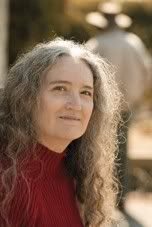
- Theresa Williams
- Northwest Ohio, United States
- "I was no better than dust, yet you cannot replace me. . . Take the soft dust in your hand--does it stir: does it sing? Has it lips and a heart? Does it open its eyes to the sun? Does it run, does it dream, does it burn with a secret, or tremble In terror of death? Or ache with tremendous decisions?. . ." --Conrad Aiken
Facebook Badge

Subscribe
Posts
All Comments
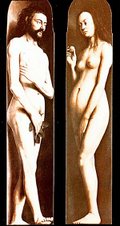
Fave Painting: Eden
Fave Painting: The Three Ages of Man and Death
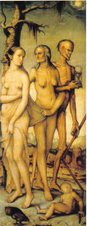
by Albrecht Dürer
My Original Artwork: Triptych
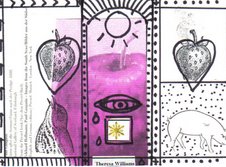
Wishing
Little Deer
Transformation
Looking Forward, Looking Back