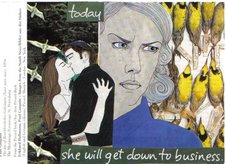
When the ground is snow-covered you really wonder why this isn't called Winter Semester.
I looked around my livingroom this afternoon. Since we gave up TV, the chairs are no longer pointed at the tube. They are pointed at the woodheater. This is one reason why I love winter, the woodheater. I love it that fire is the focal point of our house. I always feel sad when spring arrives and the heater goes dead.
I am excited to think of my students reading James Wright and Georg Trakl together.
Showing posts with label television. Show all posts
Showing posts with label television. Show all posts
Thursday, January 14, 2010


Sunday, September 21, 2008
Flying
I had a flying dream last night. I hadn't had one of those in a long while.
I think the dream was instigated by watching Peter and the Wolf on PBS last night. In the tale, a delightful little bird has trouble flying and Peter ties a helium balloon around its breast. The bird hopped, bounced, and sometimes soared. That is exactly what my flying dreams are like: I hop and bounce like I'm attached to a balloon that isn't quite large enough to get me off the ground. But after a few false starts, I soar. Sometimes I just float; other times, like in last night's dream, I hold my arms out like airplane wings.
In last night's dream, the air was filled with people flying.
I think the dream was instigated by watching Peter and the Wolf on PBS last night. In the tale, a delightful little bird has trouble flying and Peter ties a helium balloon around its breast. The bird hopped, bounced, and sometimes soared. That is exactly what my flying dreams are like: I hop and bounce like I'm attached to a balloon that isn't quite large enough to get me off the ground. But after a few false starts, I soar. Sometimes I just float; other times, like in last night's dream, I hold my arms out like airplane wings.
In last night's dream, the air was filled with people flying.
Friday, July 06, 2007
The "L" Word
 Photo: Bernie Mac
I really enjoy Tavis Smiley. It comes on late at night on PBS. The other night Tavis had Bernie Mac on his show. Tavis told Bernie that Bernie was the only entertainer who'd ever spoken of his work as being inspired by love. Bernie told the story of being a little boy and sitting on his mother's lap. His mother was dying, of cancer, I think. Bernie asked his mother why she was crying. Then, Bernie said, Bill Cosby came on The Ed Sullivan Show. As Cosby did his act, Bernie's mother began to laugh. Her laughter and her tears mixed together. Bernie said he told his mother then that he wanted to be a comedian because he wanted to find a way to stop his mother's tears.
I wanted to write this story down before I forgot it because, it seems to me, that writers have similar stories about why they write. I remember doing newsletters to entertain my friends. I wrote countless notes and letters to family and friends. I had pen-pals from France, India, Hong Kong, and South Africa. I enjoyed doing presentations in school, especially after I had my whole sixth grade class in stitches after telling a joke and then pretending to be afraid. My teacher had tears streaming down her face, she laughed so hard. It was a wonderful feeling to bring the class together in laughter. There were so many differences among us, race (schools had just been desegregated the year before) and physical maturity (some of us were still children while others were becoming adolescents).
The thought of giving pleasure to people through my writing was what drove me to create all the way through junior high school. I think the same is true now, although my reasons for writing are varied and complex. But, yes, love is definitely a big factor.
I feel that people are reluctant to reveal that their art comes out of love. The "L" word isn't very scholarly. And it's hard to write an argumentative essay about love. The "L" word is kind of a dirty word in academia because it doesn't fit into any theory of art whatsoever. Yet e.e. cummings, quoting Rilke in his famous "Non Lectures," said art comes from love.
Tuesday, September 12, 2006
Expanding the reach of who you are
Tonight I watched Faith and Doubt at Ground Zero on PBS for the second time. The first time I saw it was several months ago. It's a powerful exploration of how people's belief in God changed after 9/11. Kirk Varnedoe, the former director of the Museum of Modern Art, had the following to say about art and religion:
People say art is a substitute religion, and I thought about a lot about that in the aftermath of 9/11. It's true that art transports you, that it gives you the sense that you can find other worlds than the ones that you know are inside of you. There are so many imagined worlds. Each artist creates a world with its own logic and its own set of rules in which you can move in and inhabit. They find form that lets you imaginatively take part in experiences with which you may not have had any contact, and for a moment, conceive of a world as pearlescent and as beautifully, rectilinearly ordered as a Piero. To feel these things through art expands the reach of who you are.
But art doesn't only transport you to new, imagined places. It also, in the best sense, narrows your vision, focuses with a new immediacy on the things that may be the most familiar to you. It gives a new spiritual dimension to the objects that you touch, to the room that you inhabit. And this is not just a tidy or comfortable experience but can be suffused with a kind Dionysian pleasure, in the sense of the small world controlled and the poetry of the world possessed, this crossing over of the line between what is the love of the material thing, of the dust mote in the sunlight or the sheen of the porcelain, of the look of the ivy winding around the bowl of fish, you know, this sort of pleasure in the daily small things. In art, through art, I think, transmutes itself into a form of spirituality, one to which I respond very, very strongly. --KIRK VARNEDOE, former directer of MoMA
I believe this transport was also experienced by van Gogh. In his letters he speaks so much about the power of color to transport him; he had a special affinity for yellow. Van Gogh's experience with art is particularly intriguing, since he once wanted to go into the ministry. Can it be that art became his religion?
The poets Dickey, Roethke, and James Wright spoke of poetry transporting them. Dickey described being on a city street with Wright and Robert Bly and sinking to his knees in awe of poetry. I've read many of James Wright's letters, in which he speaks of reading, or writing, a poem and of transcending the ordinary. James Agee, who also wrote poetry, but who is mostly known for his prose works, like Death in the Family, also wrote of how his struggle with art led him to ephiphany.
In my own case, I feel a sense of rightness and connectedness when the writing is going well. It's as though the neurons in my brain are firing in just the right pattern, allowing me to experience many things at once, and through this explosive integration, I'm able to see the "truth." (In a recent Sun article, the author says scientists have actually observed this phenomenon in the brain.) Joseph Campbell called this a "peak" moment, and he connected it with the transcendent. When I reach this point while writing, it feels similar to moments I used to have in church back in the late 1970s when I felt a sudden rush of love.
I have to think about whether I agree that art is a "substitute" religion. Vernedoe doesn't say whether or not he agrees, but he does say that we can experience a form of spirituality through art. I do really like what Varnedoe says about what art does, that it expands the imagination and at the same time it narrows your vision. It gives you a chance to focus on very specific things so that you can see how sacred they are. At the same time, it opens you to mystery. Yes, I really like that explanation.
People say art is a substitute religion, and I thought about a lot about that in the aftermath of 9/11. It's true that art transports you, that it gives you the sense that you can find other worlds than the ones that you know are inside of you. There are so many imagined worlds. Each artist creates a world with its own logic and its own set of rules in which you can move in and inhabit. They find form that lets you imaginatively take part in experiences with which you may not have had any contact, and for a moment, conceive of a world as pearlescent and as beautifully, rectilinearly ordered as a Piero. To feel these things through art expands the reach of who you are.
But art doesn't only transport you to new, imagined places. It also, in the best sense, narrows your vision, focuses with a new immediacy on the things that may be the most familiar to you. It gives a new spiritual dimension to the objects that you touch, to the room that you inhabit. And this is not just a tidy or comfortable experience but can be suffused with a kind Dionysian pleasure, in the sense of the small world controlled and the poetry of the world possessed, this crossing over of the line between what is the love of the material thing, of the dust mote in the sunlight or the sheen of the porcelain, of the look of the ivy winding around the bowl of fish, you know, this sort of pleasure in the daily small things. In art, through art, I think, transmutes itself into a form of spirituality, one to which I respond very, very strongly. --KIRK VARNEDOE, former directer of MoMA
I believe this transport was also experienced by van Gogh. In his letters he speaks so much about the power of color to transport him; he had a special affinity for yellow. Van Gogh's experience with art is particularly intriguing, since he once wanted to go into the ministry. Can it be that art became his religion?
The poets Dickey, Roethke, and James Wright spoke of poetry transporting them. Dickey described being on a city street with Wright and Robert Bly and sinking to his knees in awe of poetry. I've read many of James Wright's letters, in which he speaks of reading, or writing, a poem and of transcending the ordinary. James Agee, who also wrote poetry, but who is mostly known for his prose works, like Death in the Family, also wrote of how his struggle with art led him to ephiphany.
In my own case, I feel a sense of rightness and connectedness when the writing is going well. It's as though the neurons in my brain are firing in just the right pattern, allowing me to experience many things at once, and through this explosive integration, I'm able to see the "truth." (In a recent Sun article, the author says scientists have actually observed this phenomenon in the brain.) Joseph Campbell called this a "peak" moment, and he connected it with the transcendent. When I reach this point while writing, it feels similar to moments I used to have in church back in the late 1970s when I felt a sudden rush of love.
I have to think about whether I agree that art is a "substitute" religion. Vernedoe doesn't say whether or not he agrees, but he does say that we can experience a form of spirituality through art. I do really like what Varnedoe says about what art does, that it expands the imagination and at the same time it narrows your vision. It gives you a chance to focus on very specific things so that you can see how sacred they are. At the same time, it opens you to mystery. Yes, I really like that explanation.
Subscribe to:
Posts (Atom)
Subscribe To


 Posts
All Comments
Posts
All Comments
Dreaming
About Me
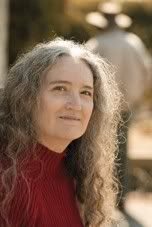
- Theresa Williams
- Northwest Ohio, United States
- "I was no better than dust, yet you cannot replace me. . . Take the soft dust in your hand--does it stir: does it sing? Has it lips and a heart? Does it open its eyes to the sun? Does it run, does it dream, does it burn with a secret, or tremble In terror of death? Or ache with tremendous decisions?. . ." --Conrad Aiken
Facebook Badge

Subscribe
Posts
All Comments
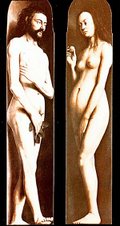
Fave Painting: Eden
Fave Painting: The Three Ages of Man and Death
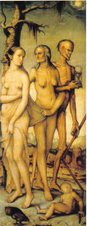
by Albrecht Dürer
My Original Artwork: Triptych
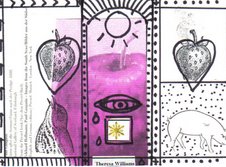
Wishing
Little Deer
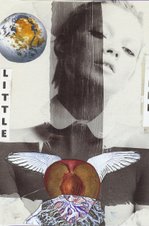
Transformation
Looking Forward, Looking Back