I've thought how to explain what the Provincetown Residency means to me. My ideas for how to express it seemed too shallow. Today, my eyes fell upon a Theodore Roethke poem. My good friend Roethke will help me to explain. His poem, "The Right Thing" speaks my inner thoughts today:
The Right Thing
by Theodore Roethke
Let others prove the mystery if they can.
Time-harried prisoners of Shall and Will--
The right thing happens to the happy man.
Yes, I have been that prisoner of "Shall" and "Will." I have let my brain be torn apart by fear and doubt. I have had a preconceived idea about what is "the right thing" for me. I have tried to second-guess life. This year when I filled out the application for the residency, I just told the truth and let the chips fall where they may. I wasn't nervous or afraid or lacking in confidence. I was calm and peaceful and confident. When I chose my writing sample, I didn't second-guess. I sent a recent story that is simple and true. In short, I was happy. The Provincetown Residency will be the vehicle for helping me to live in that place for an extended period of time. I won't find it and then be jerked out of it by obligations or other realities.
The bird flies out, the bird flies back again;
The hill becomes the valley, and is still;
Let others delve that mystery if they can.
I try too hard. Obligations take me out of my soul. The bird flies back to my soul. It is a rending, a tearing. Sometimes I think it will make me mad. One day I'm on a hill, confident, exuberant; then right behind that is the valley, doubts and darkness. But what if the hill and the valley were the same? What if there is no right or wrong; it is the same thing? It is all "right" if we accept that it is right, feel that.
As Yoda said, there is no try, only do. In that moment of doing, all is right.
God bless the roots!--Body and soul are one!
The small become the great, the great the small;
The right thing happens to the happy man.
Perfect balance.
Child of the dark, he can out leap the sun,
His being single, and that being all:
The right thing happens to the happy man.
Perfect balance.
Or he sits still, a solid figure when
The self-destructive shake the common wall;
Takes to himself what mystery he can,
Put the currency of the soul in the bank, so when you feel ready to give in to doubt and fear, you can plumb the mystery again of perfect balance.
And praising change as the slow night comes on,
Wills what he would, surrendering his will
Till mystery is no more: No more he can.
The right thing happens to the happy man.
Acceptance. Complete acceptance. Pure acceptance. Whether the slow night is doubt and fear or the passing of time towards mortality, you do your best. Make changes where you can, surrender you will when you cannot. It is not a mystery; just be. Find that true place. Live from there. Then you are happy. Everything, no matter what, is the right thing.
The Provincetown Residency will take me on this voyage, into the true place where everything is the right thing. What a gift.
Showing posts with label poet-seeker. Show all posts
Showing posts with label poet-seeker. Show all posts
Tuesday, April 29, 2008


Monday, November 12, 2007
On Nov. 12
On this day in 1935, 27-year-old Theodore Roethke was hospitalized for the first of the manic-depressive breakdowns that would recur throughout his life. Roethke had just begun a teaching post at Michigan State University and, according to colleagues, had been drinking heavily all semester, dozens of cups of coffee and bottles of cola a day as well as alcohol. On the previous evening, a cold one, he had taken a long walk in the woods without a coat and eventually with only one shoe; the next morning, after deciding "to cut my eight o'clock class deliberately just to see how long they would stick around," Roethke took another walk in the woods, also coatless. He was shivering and delirious when he arrived at the dean's office, where he planned "to explain one or two things about this experiment"; the dean, trained as a mathematician, called for the doctors. Roethke later told friends that while on his first walk he had had a mystical experience with a tree -- even pointed out the tree, while retrieving his shoe. The tree taught him "the secret of Nijinsky," he said, perhaps referring to that passage in Nijinsky's diary -- written while Nijinsky was a mental patient -- that describes learning from a tree that "human beings do not understand feelings."
Wednesday, July 25, 2007
Seeking
This is a repost from my old AOL Journal which I left after AOL put Ads on the journals of its paying members. That's why, by the way, this blog is called "exile edition."
Cynthia recently posted something about having a "calling" and I thought I remembered doing an entry at the AOL Journal about "the call." I wanted to repost it for her. But I couldn't find it. However, I did find this one. I wrote it back in 2004, not long after I started the journal. It seems to me to be relevant to a good number of things in my life right now:
________________________________
The word "seek" is etymologically related, not to "see," as might appear to be the case, but to "sagacious." What is needed is not simply seeing but a quality of discernment regarding what is seen, a piercing insight that looks deeper than mere surface appearances. --Natalie Baan
Being a writer also means being a seeker. This means finding the clear path to my creativity, which is the same as finding a clear path to my "self."
Life's troubles, like the devil, can waylay you as you try to walk the path. The path is the way, in other words, freedom. The Chinese call this concept tao. They were well aware how easy it is to lose one's path. Lao-tzu wrote, "Heaven and earth are ruthless. To them the ten thousand things are but strawdogs. Life imposes its troubles on us and is indifferent to our longings and fears."
As a writer I want to aspire to be a sage, one who understands the tao of things and is not unduly disturbed. I don't want to become entangled with everything I meet and become untrue to myself. Chuang-tzu says of people who are untrue to themselves: "Day after day they use their minds in strife. Their little fears are mean and trembly; their great fears are stunned and overwhelming."
I want to become a person true to myself, my path. "The 'True Person'of Lao-tzu and Chuang-tzu lives fully in the world without being overwhelmed by its frenzy and muddle. He is impervious to the social pressures bearing down on him. 'He can commit an error and not regret it, meet with success and not make a show.'"
Lao-tzu says the way of the sage is like water, which "benefits the ten thousand creatures; yet itself does not scramble, but is content with the places that all men disdain."
Can the way of the writer, then, be like water? A flowing and nourishing act? That is how I would like writing to be for me.
Everything is a pitfall for the unwary and the faithless. And nothing is a pitfall for the courageous seeker who just shakes it off like a bear. --Shri Parthasarathi Rajagopalachari
Ideas about tao taken from Stephen Batchelor's "The Devil in the Way."
Cynthia recently posted something about having a "calling" and I thought I remembered doing an entry at the AOL Journal about "the call." I wanted to repost it for her. But I couldn't find it. However, I did find this one. I wrote it back in 2004, not long after I started the journal. It seems to me to be relevant to a good number of things in my life right now:
________________________________
The word "seek" is etymologically related, not to "see," as might appear to be the case, but to "sagacious." What is needed is not simply seeing but a quality of discernment regarding what is seen, a piercing insight that looks deeper than mere surface appearances. --Natalie Baan
Being a writer also means being a seeker. This means finding the clear path to my creativity, which is the same as finding a clear path to my "self."
Life's troubles, like the devil, can waylay you as you try to walk the path. The path is the way, in other words, freedom. The Chinese call this concept tao. They were well aware how easy it is to lose one's path. Lao-tzu wrote, "Heaven and earth are ruthless. To them the ten thousand things are but strawdogs. Life imposes its troubles on us and is indifferent to our longings and fears."
As a writer I want to aspire to be a sage, one who understands the tao of things and is not unduly disturbed. I don't want to become entangled with everything I meet and become untrue to myself. Chuang-tzu says of people who are untrue to themselves: "Day after day they use their minds in strife. Their little fears are mean and trembly; their great fears are stunned and overwhelming."
I want to become a person true to myself, my path. "The 'True Person'of Lao-tzu and Chuang-tzu lives fully in the world without being overwhelmed by its frenzy and muddle. He is impervious to the social pressures bearing down on him. 'He can commit an error and not regret it, meet with success and not make a show.'"
Lao-tzu says the way of the sage is like water, which "benefits the ten thousand creatures; yet itself does not scramble, but is content with the places that all men disdain."
Can the way of the writer, then, be like water? A flowing and nourishing act? That is how I would like writing to be for me.
Everything is a pitfall for the unwary and the faithless. And nothing is a pitfall for the courageous seeker who just shakes it off like a bear. --Shri Parthasarathi Rajagopalachari
Ideas about tao taken from Stephen Batchelor's "The Devil in the Way."
Tuesday, January 16, 2007
"During December's Death"
 Photo: Image from an album by Nick Drake
Delmore Schwartz mentions December in several of his poems. This is probably because he was born in December (8th). I think we all see deep significance in the month in which we were born.
December has always been one of my favorite months. It probably started out that way because of Christmas. Later, December signaled time off from school. My mother's birthday was in December and my youngest son was born December 30.
Now I appreciate December's darkness, the solstice, and all the solstice represents about death and renewal.
Delmore Schwartz didn't make the cut for the seminar I'm teaching. I'll still be able to share some of his personal lyrics with the class, though. Before Christmas, I allowed them to choose which authors they wanted to look at closely and they chose: William Blake, Walt Whitman, Theodore Roethke, James Wright, John Berryman, Anne Sexton, Tobias Wolfe, and Dorothy Allison.
I suspect no one chose Schwartz because they'd never heard of him, so that's why it's important that I introduce them to this fine poet, at least. Schwartz's "During December's Death" definitely is about thresholds:
The afternoon turned dark early;
The light suddenly faded;
The dusk was black although, elsewhere, the first star in the cold sky
suddenly whistled,
And I thought I heard the fresh scraping of the flying steel of boys on
roller skates
Rollicking over the asphalt in 1926,
And I thought I heard the dusk and silence raided
By a calm voice commanding consciousness:
Wait: wait: wait as if you had always waited
And as if it had always been dark
And as if the world had been from the beginning
A lost and drunken ark in which the only light
Was the dread and white of the terrified animals' eyes.
And then, turning on the light, I took a book
That I might gaze upon another's vision of the abyss of conscious-
ness--
The hope, and the pain of hope, and the patience of hope and its
torment, its astonishment, its endlessness.
Here is an image of death as the abyss, terrible death as it exists in nature, a place not ordered but chaotic, a "drunken ark." Schwartz focuses on the frightening moment before the dark predator--death-- strikes.
I think it's odd how this poem foretells Schwartz's death, almost as though he had a premonition that he would die white-eyed with terror.
I love the last lines, where the speaker, frightened by the voices from the dark, takes a book and searches for the hope of renewal that death brings: death's "hope...pain of hope...patience of hope...its torment, its astonishment, its endlessness."
What better month than December to embody all this? December is a threshold-month.
Delmore Schwartz loved poetry; he loved to write. I think he tried until the very end to give himself ENTIRELY to what he loved best; He encouraged his friend, John Berryman, to do the same. Without Schwartz's encouragement, Berryman probably wouldn't have gone as far as he did with his writing.
December has always been one of my favorite months. It probably started out that way because of Christmas. Later, December signaled time off from school. My mother's birthday was in December and my youngest son was born December 30.
Now I appreciate December's darkness, the solstice, and all the solstice represents about death and renewal.
Delmore Schwartz didn't make the cut for the seminar I'm teaching. I'll still be able to share some of his personal lyrics with the class, though. Before Christmas, I allowed them to choose which authors they wanted to look at closely and they chose: William Blake, Walt Whitman, Theodore Roethke, James Wright, John Berryman, Anne Sexton, Tobias Wolfe, and Dorothy Allison.
I suspect no one chose Schwartz because they'd never heard of him, so that's why it's important that I introduce them to this fine poet, at least. Schwartz's "During December's Death" definitely is about thresholds:
The afternoon turned dark early;
The light suddenly faded;
The dusk was black although, elsewhere, the first star in the cold sky
suddenly whistled,
And I thought I heard the fresh scraping of the flying steel of boys on
roller skates
Rollicking over the asphalt in 1926,
And I thought I heard the dusk and silence raided
By a calm voice commanding consciousness:
Wait: wait: wait as if you had always waited
And as if it had always been dark
And as if the world had been from the beginning
A lost and drunken ark in which the only light
Was the dread and white of the terrified animals' eyes.
And then, turning on the light, I took a book
That I might gaze upon another's vision of the abyss of conscious-
ness--
The hope, and the pain of hope, and the patience of hope and its
torment, its astonishment, its endlessness.
Here is an image of death as the abyss, terrible death as it exists in nature, a place not ordered but chaotic, a "drunken ark." Schwartz focuses on the frightening moment before the dark predator--death-- strikes.
I think it's odd how this poem foretells Schwartz's death, almost as though he had a premonition that he would die white-eyed with terror.
I love the last lines, where the speaker, frightened by the voices from the dark, takes a book and searches for the hope of renewal that death brings: death's "hope...pain of hope...patience of hope...its torment, its astonishment, its endlessness."
What better month than December to embody all this? December is a threshold-month.
Delmore Schwartz loved poetry; he loved to write. I think he tried until the very end to give himself ENTIRELY to what he loved best; He encouraged his friend, John Berryman, to do the same. Without Schwartz's encouragement, Berryman probably wouldn't have gone as far as he did with his writing.
Monday, January 15, 2007
"The Poet"
 Photo: Delmore Schwartz
Gretchen mentioned Delmore Schwartz's "The Poet." I went back to read it, too, and I decided to post it.
The Poet
The riches of the poet are equal to his poetry
His power is his left hand
It is idle weak and precious
His poverty is his wealth, a wealth which may destroy him
like Midas Because it is that laziness which is a form of impatience
And this he may be destroyed by the gold of the light
which never was
On land or sea.
He may be drunken to death, draining the casks of excess
That extreme form of success.
He may suffer Narcissus' destiny
Unable to live except with the image which is infatuation
Love, blind, adoring, overflowing
Unable to respond to anything which does not bring love
quickly or immediately....
The poet must be innocent and ignorant
But he cannot be innocent since stupidity is not his strong
point
Therefore Cocteau said, "What would I not give
To have the poems of my youth withdrawn from
existence?I would give to Satan my immortal soul."
This metaphor is wrong, for it is his immortal soul which
he wished to redeem,
Lifting it and sifting it, free and white, from the actuality of
youth's banality, vulgarity,
pomp and affectation of his early
works of poetry.
So too in the same way a Famous American Poet
When fame at last had come to him sought out the fifty copies
of his first book of poems which had been privately printed
by himself at his own expense.
He succeeded in securing 48 of the 50 copies, burned them
And learned then how the last copies were extant,
As the law of the land required, stashed away in the national capital,
at the Library of Congress.
Therefore he went to Washington, therefore he took out the last two
copies
Placed them in his pocket, planned to depart
Only to be halted and apprehended. Since he was the author,
Since they were his books and his property he was reproached
But forgiven. But the two copies were taken away from him
Thus setting a national precedent.
For neither amnesty nor forgiveness is bestowed upon poets, poetry and poems,
For William James, the lovable genius of Harvard
spoke the terrifying truth: "Your friends may forget, God
may forgive you, But the brain cells record
your acts for the rest of eternity."
What a terrifying thing to say!
This is the endless doom, without remedy, of poetry.
This is also the joy everlasting of poetry.
Delmore Schwartz
1913-1966
Threshold
 Walt Whitman
Gretchen, who so often contributes such thoughtful remarks at this blog, recently asked me to reply to her about what makes good poetry. She acted as the muse I needed to say something about that.
The best way to become a better poet is to read as much poetry as you can, to find the poets who really speak to you and read that, read lots of it, and live it as you read it. Teachers can help, but the thing is to find your voice.
I think this is why I love reading about poets whom I love, about their struggles to break away from the marble icons in order to find what it is they want to say, and how to say it. It is a journey that has joy but it also hurts. It is very intense. Each poet has that poem that represents a turn about: with Wright, I think, it is when he ended his poem by saying, "I have wasted my life." This is also what Berryman is saying when he admits he wanted to "be Yeats." Until you break through to your real self, you will never write the poetry you are meant to write.
You feel it when it happens, when you express something with great clarity and beauty (even if it is a terrible subject), and control.
Beyond that, I think we all have to work at finding the right metaphors, not to strain after the metaphors, but to find the ones that feel natural, the ones that sing. I have been reading Ask the Dust by John Fante, and his work is so simple, and the metaphors are so perfect that reading his story is effortless and at the same time exhilarating. Again, find the authors who take you to your threshold. In Poetry As Survival, Gregory Orr devotes a chapter to "The Edge as Threshold." He uses "threshold" as in psychology, to mean "the point where a stimulus is of sufficient intensity to produce an effect."
Orr says something that I have believed for a long time, that "arguments about taste, about whether a particular poem is 'great' or not, simply have to do with differences in readers' thresholds." I'm reminded of a story that Eileen Simpson tells about John Berryman and Delmore Schwartz. Once Schwartz was at the Berrymans' house and John played a record he was really hot for Delmore to hear, one by Bessie Smith. John was excessively moved by it and wanted to share it with Delmore. But as the record played, Delmore got out of his chair and moved around the room restlessly. The record just didn't bring Delmore Schwartz to his threshold; it had nothing to do with whether Bessie Smith was "great" or not. As Orr states, "The essential point is that for a poem to move us it must bring us near our own threshold."
Orr also mentions Whitman (a poet who did little for me when I was in my twenties, but now I hang on his every word). Orr says that Whitman intended for people to not just go to the threshold but "to venture further out than they were accustomed to going and thereby to stretch themselves and extend their spirits." Orr quotes from Whitman:
Long have you timidly waded holding a plank by the shore
Now I will you to be a bold swimmer,
To jump off in the midst of the sea, rise again, nod to me, shout, and
laughingly dash with your hair.
(Song of Myself)
Finally, Orr explains quite clearly what the effect of being brought to your threshold means: "That effect is both a sudden awareness of the disorder (the initiating moment of feeling destabilized) and the imagination's ordering response to it." He also says, "We must feel genuinely threatened or destabilized by the poem's vision of disordering, even as we are simultaneously reassured and convinced by its orderings."
Going back to the Whitman poem (next to which I marked "Wow" in Orr's text), I can clearly see why these words move me. It is because I am afraid of water and have a memory of taking swimming lessons and being told to let go of the ledge. I remember how scared I was, how I kept reaching for the ledge. I know I also do this in life; I am always looking for a ledge to steady me so that I'm not lost in the abyss. But I also know the joy of water. There have been moments when I've pushed off the side of the pool and gloried in the freedom of water, when I've been that "bold swimmer." That poem really hits me where I live every day.
The best way to become a better poet is to read as much poetry as you can, to find the poets who really speak to you and read that, read lots of it, and live it as you read it. Teachers can help, but the thing is to find your voice.
I think this is why I love reading about poets whom I love, about their struggles to break away from the marble icons in order to find what it is they want to say, and how to say it. It is a journey that has joy but it also hurts. It is very intense. Each poet has that poem that represents a turn about: with Wright, I think, it is when he ended his poem by saying, "I have wasted my life." This is also what Berryman is saying when he admits he wanted to "be Yeats." Until you break through to your real self, you will never write the poetry you are meant to write.
You feel it when it happens, when you express something with great clarity and beauty (even if it is a terrible subject), and control.
Beyond that, I think we all have to work at finding the right metaphors, not to strain after the metaphors, but to find the ones that feel natural, the ones that sing. I have been reading Ask the Dust by John Fante, and his work is so simple, and the metaphors are so perfect that reading his story is effortless and at the same time exhilarating. Again, find the authors who take you to your threshold. In Poetry As Survival, Gregory Orr devotes a chapter to "The Edge as Threshold." He uses "threshold" as in psychology, to mean "the point where a stimulus is of sufficient intensity to produce an effect."
Orr says something that I have believed for a long time, that "arguments about taste, about whether a particular poem is 'great' or not, simply have to do with differences in readers' thresholds." I'm reminded of a story that Eileen Simpson tells about John Berryman and Delmore Schwartz. Once Schwartz was at the Berrymans' house and John played a record he was really hot for Delmore to hear, one by Bessie Smith. John was excessively moved by it and wanted to share it with Delmore. But as the record played, Delmore got out of his chair and moved around the room restlessly. The record just didn't bring Delmore Schwartz to his threshold; it had nothing to do with whether Bessie Smith was "great" or not. As Orr states, "The essential point is that for a poem to move us it must bring us near our own threshold."
Orr also mentions Whitman (a poet who did little for me when I was in my twenties, but now I hang on his every word). Orr says that Whitman intended for people to not just go to the threshold but "to venture further out than they were accustomed to going and thereby to stretch themselves and extend their spirits." Orr quotes from Whitman:
Long have you timidly waded holding a plank by the shore
Now I will you to be a bold swimmer,
To jump off in the midst of the sea, rise again, nod to me, shout, and
laughingly dash with your hair.
(Song of Myself)
Finally, Orr explains quite clearly what the effect of being brought to your threshold means: "That effect is both a sudden awareness of the disorder (the initiating moment of feeling destabilized) and the imagination's ordering response to it." He also says, "We must feel genuinely threatened or destabilized by the poem's vision of disordering, even as we are simultaneously reassured and convinced by its orderings."
Going back to the Whitman poem (next to which I marked "Wow" in Orr's text), I can clearly see why these words move me. It is because I am afraid of water and have a memory of taking swimming lessons and being told to let go of the ledge. I remember how scared I was, how I kept reaching for the ledge. I know I also do this in life; I am always looking for a ledge to steady me so that I'm not lost in the abyss. But I also know the joy of water. There have been moments when I've pushed off the side of the pool and gloried in the freedom of water, when I've been that "bold swimmer." That poem really hits me where I live every day.
Saturday, December 02, 2006
Hy Sobiloff's Child Within
From a poem by Hy Sobiloff:
Speak to me child speak to me
You are learning
Yet you may teach me again the sweetness and the curdle
And tell me of the kid that is nursing under the sapodilla tree
And of the seashell I lost
And of those first scenes that I've forgotten
Speak to me of the innocence in the wading pond
That survives somewhere (I shall comment on the miracle)
Open your secrets to me
While I stare at your stare
Show me the buzzard ugly enough to die
The ground dove that has a hermitage
Tell me of the dogs that are better than cats
Cats cannot catch goats
Explain why that child is sitting by the road
Nodding and shaking and no-one there
I shall give you a biscuit
And let you eat it with dirty hands...
Promise me child before you disappear in hide-and-seek
That your next step will be the fiction of this world
That when you leave the broken wall
You will keep your lizard spontaneities...
-----------------------------------------
In 1963, the poet James Wright wrote an introduction to Hyman Sibiloff's poetry collection "Breathing of First Things." In this introduction, Wright seems to chide those who see the quest for the child within as naive or, worse (for Wright), unmanly. Wright says that the rediscovery of what he calls the true self, with its healing powers, necessarily involves a search for the child within, which he equates with the ability to experience wonder through the senses, the ability to see the miraculousness of things, to feel truly alive. In the introduction, Wright says:
"[...] the struggle to be true to one's own self involves a good deal more than the rediscovery of a childlike radiance and joy, though that rediscovery may lie at the end of the journey. The journey itself is a dark one. It is neither more nor less than the attempt to locate and reclaim those healing powers within one's self that are able to provide sufficient courage and literal physical strength for one to confront and overcome the agonies of the world which exists beyond the womb and which, for better or worse, does not happen to be shaped and arranged in a pattern identical with the orchards and rivers and meadows of that earliest garden, sunken now almost below the memory and, whether wasted or redeemed, lost somewhere between the morning of dancing animals and the tousled dusk of sorrowing human faces. Beyond that garden we live a good deal of our death. We may insist on returning to seek it by trying to ignore the shocks and miseries that obstruct the only true way back home; and such evasions really amount to a mere refusal to live. The refusal, the negation, the despair--these are our constant familiar spirits in the twentieth century."
---------------------------------------
Wright describes the journey back to self as a dark one; I think I agree with him. But there are moments of epiphany, of light. An example is found in Sobiloff's poem. The lines in Sobiloff's poem that speak to me the most are: "I shall give you a biscuit/
And let you eat it with dirty hands..."
The reason why those lines are meaningful to me is that I got an immediate image, upon reading them, of myself, very small, innocently eating a biscuit with my dirty hands. I remembered having eaten food with dirty hands, after just coming in from a hard day of play, good play, my hands scooping dirt and all my senses alive, picking up things, exploring them with my hands, feet, and mouth. There is such an honesty in the image of a child with dirty hands. Wright also points out that Rilke understood the power of returning to a child's wonder: "'Every door in me opens,' said Rilke, 'and my whole childhood stands all around me.'"
In one of Wright's own poems, "The Journey," in the final stanza, he writes:
...The secret
of this journey is to let the wind
Blow its dust all over your body,
To let it go on blowing, to step lightly, lightly
All the way through your ruins ...
Such a gorgeous, sensory moment.
I have more to say about this topic, but I need to let my thoughts compost a while longer.
Speak to me child speak to me
You are learning
Yet you may teach me again the sweetness and the curdle
And tell me of the kid that is nursing under the sapodilla tree
And of the seashell I lost
And of those first scenes that I've forgotten
Speak to me of the innocence in the wading pond
That survives somewhere (I shall comment on the miracle)
Open your secrets to me
While I stare at your stare
Show me the buzzard ugly enough to die
The ground dove that has a hermitage
Tell me of the dogs that are better than cats
Cats cannot catch goats
Explain why that child is sitting by the road
Nodding and shaking and no-one there
I shall give you a biscuit
And let you eat it with dirty hands...
Promise me child before you disappear in hide-and-seek
That your next step will be the fiction of this world
That when you leave the broken wall
You will keep your lizard spontaneities...
-----------------------------------------
In 1963, the poet James Wright wrote an introduction to Hyman Sibiloff's poetry collection "Breathing of First Things." In this introduction, Wright seems to chide those who see the quest for the child within as naive or, worse (for Wright), unmanly. Wright says that the rediscovery of what he calls the true self, with its healing powers, necessarily involves a search for the child within, which he equates with the ability to experience wonder through the senses, the ability to see the miraculousness of things, to feel truly alive. In the introduction, Wright says:
"[...] the struggle to be true to one's own self involves a good deal more than the rediscovery of a childlike radiance and joy, though that rediscovery may lie at the end of the journey. The journey itself is a dark one. It is neither more nor less than the attempt to locate and reclaim those healing powers within one's self that are able to provide sufficient courage and literal physical strength for one to confront and overcome the agonies of the world which exists beyond the womb and which, for better or worse, does not happen to be shaped and arranged in a pattern identical with the orchards and rivers and meadows of that earliest garden, sunken now almost below the memory and, whether wasted or redeemed, lost somewhere between the morning of dancing animals and the tousled dusk of sorrowing human faces. Beyond that garden we live a good deal of our death. We may insist on returning to seek it by trying to ignore the shocks and miseries that obstruct the only true way back home; and such evasions really amount to a mere refusal to live. The refusal, the negation, the despair--these are our constant familiar spirits in the twentieth century."
---------------------------------------
Wright describes the journey back to self as a dark one; I think I agree with him. But there are moments of epiphany, of light. An example is found in Sobiloff's poem. The lines in Sobiloff's poem that speak to me the most are: "I shall give you a biscuit/
And let you eat it with dirty hands..."
The reason why those lines are meaningful to me is that I got an immediate image, upon reading them, of myself, very small, innocently eating a biscuit with my dirty hands. I remembered having eaten food with dirty hands, after just coming in from a hard day of play, good play, my hands scooping dirt and all my senses alive, picking up things, exploring them with my hands, feet, and mouth. There is such an honesty in the image of a child with dirty hands. Wright also points out that Rilke understood the power of returning to a child's wonder: "'Every door in me opens,' said Rilke, 'and my whole childhood stands all around me.'"
In one of Wright's own poems, "The Journey," in the final stanza, he writes:
...The secret
of this journey is to let the wind
Blow its dust all over your body,
To let it go on blowing, to step lightly, lightly
All the way through your ruins ...
Such a gorgeous, sensory moment.
I have more to say about this topic, but I need to let my thoughts compost a while longer.
Saturday, February 18, 2006
The Poet-Seer: In Defense of Dickey
"Remember: our life does not turn on trivialities, but on the stars."
My, I can see I unleashed a little firestorm with my last post on James Dickey. A debate has arisen concerning Dickey's view of the poet's status in the universe. Does Dickey think he's superior to others, or not?
First, I think I may have done Dickey a disservice, posting that speech without providing relevant commentary. I'd like to provide some now, although I will admit, I'm dealing with some pretty heavy material in my studies of Agee, Wright, Bly and Dickey, some big thoughts that I haven't managed to completely wrap my mind around yet. Which is probably why I didn't include commentary on the Dickey speech in the previous post: I hadn't absorbed it yet. In other words, without being quite aware of what I was doing, I was posting Dickey's words so I could truly see them and reflect on them. I hadn't considered they could actually offend my readers' sensibilities.
Second, I think it's important to reveal at this time that I came to Dickey through reading James Wright's letters. Some of you recall that I took a river journey this past summer which lasted two months. One of the stops on the journey was Martins Ferry, Ohio, where Wright was born. I took Wright's collection of poems with me on the trip and bought Wright's letters when I returned home, after seeing the letters reviewed in The New Yorker. Wright's and Dickey's correspondence intrigued me. I was impressed at the volume of the letters they produced and at the quality of thought in them. I recently found the collection of Dickey's letters on Amazon and have just started reading them.
Third, Dickey's letters come to me at a time when I've been searching for what it means to be an artist. Those of you who have been following my blog know that I've been wrestling with my thoughts on writing and the creative life the whole time I've been blogging. I'd been wrestling with these thoughts much longer than that. At least now I've decided that I am indeed "an author," but what does that mean? What is the artist's relationship to the world? To understand the role of the artist, I've been avidly reading what artists have had to say on the matter.
My point of intersection with Dickey is in how he viewed the poet's work as a divine act. In my reading of Wright, Dickey, Bly, and Agee, I've come to understand they were very serious about their art. Wright, Dickey, and Agee were troubled men. They all drank heavily and suffered all manner of depression, alienation, and heartache. I don't think it would be exaggerating to say it was poetry that gave these men the only sense of freedom they had ever known. They were not religious in the conventional sense, but they felt the divine through their art. It's frankly quite amazing to me that I could have anything in common with these hard-living, driven men. I once thought my attitude of art's connection to the divine was feminine or soft. Seeing the attitude expressed through a strong male figure like Dickey shows me my thinking was wrong.
For these men, the poetic consciousness gave them a faculty through which to perceive the spiritual world. It gave them, they thought, an inkling into a world of "Divine Wisdom"--the world of the Sophia. Their work looked into the darkness, and, like Novalis, they saw in this darkness the great mystery of life. Their art was their way of overcoming death because through their art, they believed they had tapped into something eternal.
Novalis was a German poet living at the end of the 1700s. He had a spiritual vision at the grave of the woman he was to marry, and in this vision he came to understand the value of darkness and the mystery of life. Novalis wrote:
...then, out of the blue distances, from the hills of my ancient bliss, came a shiver of twilight, and at once snapt the bond of birth, the fetter of the Light. Away fled the glory of the world, and with it my mourning; the sadness flowed together into a new, unfathomable world.
I think Dickey, Wright, Bly, and Agee also had this vision. They may have experienced it in a different way than Novalis did, but their insights were hard won through a series of falls, sufferings, and finally a kind of resurrection through their art. Certainly, Dickey and the others were drawn to poets like Novalis, de Nerval, Neruda, Trakl, and Vallejo, poets who had entered this darkness either through suffering or madness, sometimes both.
This, I think, is what Dickey means when he says the poet is elevated. This poet-seer, through art, has access to the great mysteries of life, what Dickey refers to as "the secret." It's this mystery that Dickey elevates above the trivialities of culture, the schlock culture, along with its "general icons." It may help to know that Dickey worked in advertising for a while in order to pay the bills. In one letter, in fact, he draws a distinction between a Coca Cola ad he was working on and Shakespeare. Coca Cola is a general icon. Coca Cola is schlock. It isn't on the same plane as Shakespeare, or de Nerval, or Novalis. Coca Cola is not divine, in Dickey's view.
"Away fled the glory of the world," Novalis wrote. In other words, Novalis had seen "the secret" and nothing could compare.
To further illustrate what Dickey may have meant by poets being "up there" and general icons being "down there," consider something that Wright wrote to Robert Bly: "You know, I sometimes try to escape the thought, but it returns and returns and returns: that some day I shall rise at morning and simply walk outside and away, leaving everything behind, like Buddha. Yes, I shall be killed by a runaway checkbook or an insane life-insurance policy by the time I get two blocks from home."
I speak of Wright, Bly, and Dickey almost interchangeably because they were poets during the same time and were great friends who corresponded about art over a long period. They helped sharpen each other's thoughts. Wright made the comment about Buddha and life-insurance, but Dickey could just as well have. The runaway checkbook and the insane life-insurance policy are those killing forces Dickey was talking about. They are "down there," that is, trivial considerations compared to "the secret."
In Dickey's own work, his poetry and his fiction, we see a that mystery being played out through encounters with nature. Deliverance is the example most people will remember. In that novel, the river is a force that humans seek to "beat" or to "control." But Dickey believed the mystery could not be controlled, and only those who didn't understand the mystery sought to control it. Humans try to put themselves above the mystery, or "the secret."
At the beginning of this post, I included a quote from one of Wright's letters, a letter he wrote to a despairing friend. Wright and Dickey wrote many such letters to poet friends, letters of encouragement.
Wright wrote to his friend: "Remember: our life does not turn on trivialities, but on the stars."
I think this is what Dickey was saying.
There's poetry in everything. A poem isn't just a series of words, lines, or stanzas on paper. The river is poetry; a potato is poetry. A tree, a rock, the sky, a crow, a mermaid, the turkey shit my mother used to spread on her garden (which, by the way, she said was "like gold.") If you could read Dickey's letters, and Wright's, I think you'd see the absolute humility they had when it came to their role as artists. They were in complete awe of poetry and felt their inadequacies acutely.
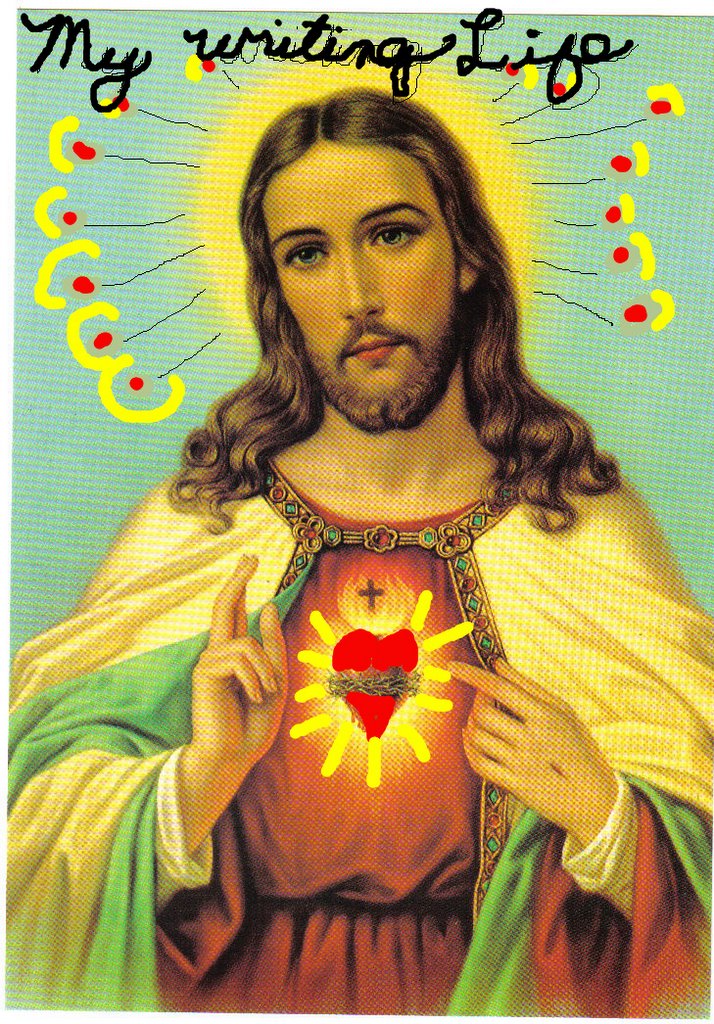
I hope I've clarified a few things for my wonderful friends and readers. Like I said, I've only begun to scratch the surface of these mysteries myself. The picture of Jesus is one I've posted before, back on my AOL blog. It was posted on one of the first entries I did. When I posted that picture of Jesus so long ago and called it "My Writing Life," I had only the vaguest notion of what the implications of that picture were. I think I'm getting closer to understanding what "My Writing Life" does indeed mean. Bear with me as I continue my search.
Sunday, November 20, 2005
Open House

OPEN HOUSE
by Theodore Roethke
My secrets cry aloud.
I have no need for tongue.
My heart keeps open house,
My doors are widely swung.
An epic of the eyes
My love, with no disguise.
My truths are all foreknown,
This anguish self-revealed.
I'm naked to the bone,
With nakedness my shield.
Myself is what I wear:
I keep the spirit spare.
The anger will endure,
The deed will speak the truth
In language strict and pure.
I stop the lying mouth;
Rage warps my dearest cry
To witness agony.
~~~~~~~~
I just posted my very last entry on my AOL Journal. I quoted Theodore Roethke's "Open House" as a way of trying to explain why I find the ads so offensive. My blog is my house. My thoughts are the opening of my house to the world. This makes my blog hallowed ground, no less hallowed than Gettysburg.
I don't think I'm going to transfer my complete AOL Journal here. I think I will just make a new start here and see where the experience takes me.
To all my AOL friends: please be patient with me. I'm slow to learn. HTML? What is that? This whole experience has been quite overwhelming. If you don't hear from me for a while, please understand I haven't forgotten you. It's just that I'm trying to find my way in new territory.
Also, I look forward to making new friends here at Blogger.
Please know that I cherish each and every comment and that your comments give me strength.
Subscribe to:
Posts (Atom)
Subscribe To


 Posts
All Comments
Posts
All Comments
Dreaming
About Me
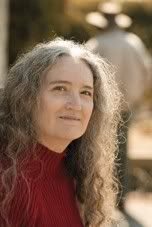
- Theresa Williams
- Northwest Ohio, United States
- "I was no better than dust, yet you cannot replace me. . . Take the soft dust in your hand--does it stir: does it sing? Has it lips and a heart? Does it open its eyes to the sun? Does it run, does it dream, does it burn with a secret, or tremble In terror of death? Or ache with tremendous decisions?. . ." --Conrad Aiken
Facebook Badge

Subscribe
Posts
All Comments
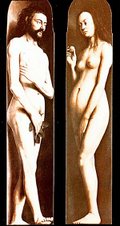
Fave Painting: Eden
Fave Painting: The Three Ages of Man and Death
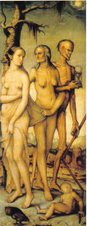
by Albrecht Dürer
My Original Artwork: Triptych
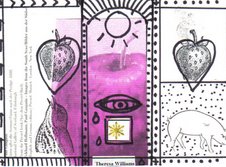
Wishing
Little Deer
Transformation
Looking Forward, Looking Back