Showing posts with label Rilke. Show all posts

Tuesday, January 06, 2009

The Rilke Project III

"Terrible Angels: For Rilke"
Conte pencil, colored pencil

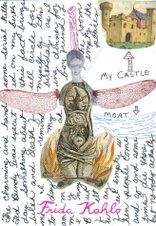
I thought about how to depict terrible angels. I didn't want to do anything that looked like a Renaissance angel. I looked at many images created by Frida Kahlo and I also looked at several books of primitive art. I decided to create two angels who are vaguely skeletal and vaguely reptilian in appearance. I included an angel in the background who is more human in appearance and bathed her in sunlight.

We can never know whether a terrible angel will be pleasing or repugnant to the eye.

In "The Man Watching," Rilke writes of the angel who wrestled humans of the Old Testament:

When the wrestler's sinews
grew long like metal strings,
he felt them under his fingers
like chords of deep music.

Rilke says that what we should want is to be beaten by this angel because in doing so, we will go away "proud and strengthened and great." Rilke says that the defeat kneads us as if to change our shape. Of the Old Testament human wrestler, Rilke says:

Winning does not tempt that man.
This is how he grows: by being defeated, decisively,
by constantly greater beings.

Monday, January 05, 2009

The Rilke Project II


"When We Win It's with Small Things: For Rilke"


In the poem "The Man Watching" by Rainer Maria Rilke (translated by Robert Bly), Rilke says:


When we win it's with small things,
and the triumph itself makes us small.
What is extraordinary and eternal
does not want to be bent by us.


The poem is about accepting what is great and eternal and allowing ourselves to be dominated by these things.


We talk all the time of overcoming our problems. This is important, too, but it is also important to learn to accept things that cannot be changed. In 2009 I want to remember this.


Saturday, January 03, 2009

The Rilke Project

"Once More My Deeper Life: For Rilke"
Conte pencil.
After a drawing in Frida Kahlo's journal.

I'm going to work with Rilke now.

I did this simple drawing with Conte pencils, using an image from Frida Kahlo's journal. I changed the drawing, giving my animal longer legs and giving the legs stripes. Kahlo's image was done in paint and bore no dedication. Her entire journal, though, is a dedication to Diego, to her great love for him.

On New Year's Eve, Allen and I drove up to Dearborn, MI to Blicks Art Store. I got hooked on the Conte pencils when I sampled one. We ended up buying the 48 pencil set, although it was very expensive. I was going to come home without it, but Allen could tell that I really wanted it and encouraged me to buy it. We also got a large set of colored pencils and other small things.

I've never worked with Conte pencils, but all of my attempts with pastels in the past were awful failures. I always overworked them, and they were just a muddy mess. This is my first try with the Conte pencils and at least I can say I didn't overwork the drawing. I hope to get better with my image-making as time goes on.

This drawing was done on a sheet of drawing paper folded in half. I'm going to do several pages dedicated to Rilke and then stitch them together into a book.

Why Rilke? Because I love him. Because he understood solitude and because of that understanding was drawn to Picasso's Family of Saltimbanques. Because Rilke put his art at the center of his life and found his salvation there.

The lettering inside the sun in my drawing is from a Rilke poem: "Once more my deeper life goes on with more strength...and the paintings I see seem much more seen into."

When I looked at the Kahlo image from her journal, I saw it with my deeper life. In that moment of seeing, really seeing, I wanted to use her work as a model and make it mine.

On another page of her journal, she wrote of trying out new pencils. That made me smile, since I, too, was trying out new pencils:

I'll try out the pencils
sharpened to the point of infinity
which always sees ahead:
Green-good warm light
Magenta-Aztec, old TLAPALI
blood of prickly pear, the
brightest and oldest
color of mole, of leaves becoming
earth
madness sickness fear
part of the sun and of happiness
electricity and purity love
nothing is black--really nothing

leaves, sadness, science, the whole
of Germany is this color
more madness and mystery
all the ghosts wear
clothes of this color, or at
least their underclothes
color of bad advertisements
and of good business
distance. Tenderness
can also be this blue
blood?

Well, who knows!


Friday, January 02, 2009

The Harlequin

Family of Saltimbanques by Pablo Picasso, 1905

I've always been drawn to this picture. I believe the first time I encountered it was in an art history class when I was a freshman in college.

For most of my life, I was never much interested in clowns. My mother-in-law collected them because, she said, they are beings who hide their deep emotions. She was always secretive; her emotions were never on the surface. Mine often are, though I invest a lot of energy in keeping them hidden.

I think I've always loved this painting, not because it portrays clowns, but because the loneliness of all the subjects is so well portrayed. In fact, I would say that the painting reflects my inner life, the sense of separateness from others I have always felt. Even as a small child, I would watch others play rather than participate in the play.

It has been said that Harlequin is the image of Picasso himself. Jung said that artists' who paint themselves in this disguise reveal a subconscious wish to "juggle with everything while remaining aloof and irresponsible."

Artists must have a sort of coolness when they create, a distance that might be taken for aloofness or irresponsibility. A certain objectivity is necessary in order to create a true picture.

This portrait of inner loneliness fascinated Rainer Maria Rilke, one of my favorite poets, He asked the owner of Family of Saltimbanques in 1928 if he might live in the same room with the painting. Rilke later revealed that the fifth of his Duino Elegies was inspired by it:

But tell me, who are they, these acrobats, even a little
more fleeting than we ourselves--so urgently, ever since childhood,
wrong by an (oh, for the sake of whom?)
never-contented will? That keeps on wringing them,
bending them, slinging them, swinging them,
throwing them and catching them back; as though from an oily
smoother air, they come down on the threadbare
carpet, thinned by their everlasting
upspringing, this carpet forlornly
lost in the cosmos.

Wednesday, November 26, 2008

Without Darkness

I sit at 2:46 in the morning in front of the fire. I work on my laptop. This represents an improvement in my writing life. When I first got the laptop in 2002 (a replacement computer for the 10 year old desktop which was hopelessly out of date), I hoped to break the writing-room habit. That didn’t happen. I plugged the laptop into an outlet in the writing room and there the laptop stayed.

Then I got my big desktop computer. I stored the laptop away, always intending to use it “in any room of the house.” The laptop didn't emerge from the drawer until I needed to take it to Provincetown.

During my stay at Provincetown, I worked exclusively on the laptop, wherever pleased me. That seems to have broken through my mental barrier.

I am thinking tonight about the coming winter, about how the days are getting shorter. It is this time of year that I really love. I have often wondered why. In my Modern Poetry class the other day we were talking about Robert Graves’ “To Juan At Winter Solstice.” That poem set off a long discussion about humans’ need to accept change.

The beautiful thing about seasons is change. In fall and winter, the trees simply shift their emphasis from their leaves to their roots, where the life force continues on. For humans, it is so hard to let go, to let change happen. We are afraid. Some lines from Ingmar Bergman’s The Virgin Spring come to mind: the smoke, when it rises, hovers at the opening in the ceiling. It doesn’t want to leave the house. It doesn’t understand that once it leaves the house that it will have the big, wide sky to live in.

I think about this almost every day. The thought obsesses me. Whitman once wrote in a poem: “Set ope’ the doors, oh soul.” The soul needs a big space to dwell in.

The long, dark winter allows me to feel that space.

Since the change back to regular time, I have felt that surprise of looking out of the window at 5:00 in the evening and seeing darkness. I feel shock, a quickness within. This inner stirring, I know, is my soul yearning to escape the confines of the house I have built for it.

Eliot once wrote:

Teach us to care and not to care
Teach us to sit still.

The paradox of caring and not caring is central to the creative life. The paradox cannot be understood until we learn to sit still. Can one care and not care simultaneously? Yes, and the trick is to not let the seeming contradiction tear you apart.

My experiment with writing haiku is paying greater dividends than I imagined. I set an arbitrary goal to write 100 haiku in a year. I told myself I would not worry whether they were good or bad. Basho said that a haiku is only good so long as it is on the writing desk, anyway. After the haiku is written, one mustn’t dwell on it but look forward to writing the next haiku. I think I needed to be given that kind of freedom.

Writing the haiku poems has led me to writer longer poems and to stay close to my creative life.

I have a secret battle: for some reason, I feel that when I write poetry I am being disloyal to fiction. My education has set a firm line between the two genres. My conscience says to me: You are not a poet. You will never be a poet. You should be working on your novel. You are wasting time by writing all these poems.

And yet I cannot live without poetry, without reading it, without writing it. Poetry speaks to my soul, and when I write it, I am making my soul. It must be true, as has been said by others, that the poem is a dialogue with the self and the novel (or short story) is a dialogue with others. So poems must be filling a need that prose cannot fill. But I persist in punishing myself for loving poetry. I need to work on this.

Poetry cuts deep channels within me. I remember being on the Ohio River and seeing the dredgers. They make sure the water stays deep enough for the boats to get through. They keep the river navigable. Poetry keeps my inner river navigable. Without it, the traffic stops. My imagination gets sluggish and shallow.

Rilke takes a slightly different view, one that delightfully free of self-absorption:

All the things to which I give myself
Grow rich and spend me

I take this to mean that in giving ourselves to poetry, we making our specific fears and desires universal. The collective voice grows rich and strong because of the poet’s excruciating honesty.

Lately, I crave poems. I almost feel like I will die if I can’t read a poem! And reading them makes me want to write them.

Sitting here in front of the fire, I know I need this dark time. As Theodore Roethke wrote: In a dark time, “the eye begins to see.”

Presently, my defining myth is the light in the darkness: Christmas-time, Solstice, festival of lights. When the lights shine and the quiet darkness is all around, I feel peace.

I am no longer a church-goer, but I love hymns, and the hymn that resonates for me now is: “It is well / With my soul.”

When I look at the fire, I see life. I feel life in the warmth it gives off. My spirit is at rest.

“Without Darkness, nothing comes to birth.” --Kali

Dreaming

Dreaming

About Me

My photo
Northwest Ohio, United States
"I was no better than dust, yet you cannot replace me. . . Take the soft dust in your hand--does it stir: does it sing? Has it lips and a heart? Does it open its eyes to the sun? Does it run, does it dream, does it burn with a secret, or tremble In terror of death? Or ache with tremendous decisions?. . ." --Conrad Aiken

Followers

Search This Blog

Epistle, by Archibald MacLeish

What I'm Listening To

My Music

Great Artists

www.flickr.com
This is a Flickr badge showing public photos from theresarrt7. Make your own badge here.

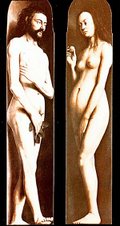
Fave Painting: Eden

Fave Painting:  Eden

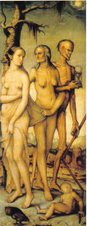
Fave Painting: The Three Ages of Man and Death

Fave Painting:  The Three Ages of Man and Death
by Albrecht Dürer

From the First Chapter

The Secret of Hurricanes : That article in the Waterville Scout said it was Shake- spearean, all that fatalism that guides the Kennedys' lives. The likelihood of untimely death. Recently, another one died in his prime, John-John in an airplane. Not long before that, Bobby's boy. While playing football at high speeds on snow skis. Those Kennedys take some crazy chances. I prefer my own easy ways. Which isn't to say my life hasn't been Shake-spearean. By the time I was sixteen, my life was like the darkened stage at the end of Hamlet or Macbeth. All littered with corpses and treachery.

My Original Artwork: Triptych

My Original Artwork:  Triptych

Wishing

Wishing

Little Deer

Little Deer

Transformation

Transformation

Looking Forward, Looking Back

Looking Forward, Looking Back
CURRENT MOON
Powered By Blogger

Labels