Showing posts with label Vonnegut. Show all posts
Saturday, April 14, 2007
Kurt Vonnegut: So It Goes
I'm not sure exactly when I discovered Kurt Vonnegut. My copy of Slaughterhouse-Five is dated 1971. That means I must have been around 15 years old when I read it. It's a Dell edition, cost $3.95. Quite possibly, it was a purchase from the Scholastic Book Club.
If so, that means my mother must have dug into the change at the bottom of her purse one early morning before I left on my bus (I got on my bus before 7 a.m. back then) for school to give me the money to buy the book. I never asked my father for book money, only my poor mother who worked until the wee hours of the morning at a cash register and sometimes moonlighted as a waitress. Her eyes heavy with sleep, she would pull the money from her purse, never complaining, indulging my love of books.
My edition is one that has those pulpy pages that have now turned brown, and several pages are marked with my faithful scrawls and underlinings from where I have read the book again and again. I have used the same edition to teach from. Many students have watched me stand in front of them, holding this book. One just told me today that before my class (one that I taught two years ago) he had never read anything by Vonnegut. Now, he has read everything and is about to write a paper on him for another class. The assignment was to write about someone whom they consider a hero.
Kurt Vonnegut is also a hero of mine. I never loved any of his other books as much as I loved Slaughterhouse-Five, but I loved Billy Pilgrim enough to make up that. "Billy Pilgrim has come unstuck in time."
But it isn't even Billy that I love most; it's the unnamed speaker at the beginning of the book, the one who intrudes on Billy's story from time to time afterwards who really commands my admiration and love. This, I suspect, is the voice of Vonnegut himself, explaining how hard it was to write Slaughterhouse-Five, to put his trauma into words, all the sad things he saw, like burning the little bodies of dead children. The narrator says:
"Celine was a brave French soldier in the First World War--until his skull was cracked. After that he couldn't sleep, and there were noises in his head. He became a doctor, and he treated poor people in the daytime and he wrote grotesque novels all night. No art is possible without a dance with death, he wrote.
The truth is death, he wrote. I've fought nicely against it as long as I could...danced with it, festooned it, waltzed it around...decorated it with streamers, titilated it..."
Then, humbly, the narrator recounts the death of Lot's wife, saying that she looked back, "and I love her for that, because it was so human. So she was turned to a pillar of salt. So it goes."
Applying the concept of looking back to himself, the narrator, an American survivor of the Dresden bombing, says:
"People aren't supposed to look back. I'm certainly not going to do it anymore.
I've finished my war book now. The next one I write is going to be fun.
This one is a failure, and had to be, since it was written by a pillar of salt. It begins like this:
Listen:
Billy Pilgrim has come unstuck in time.
It ends like this:
Poo-tee-weet?"
Vonnegut gave me the permission to see myself as pillar of salt. And that is okay because salt is necessary to life. Even when we're in the midst of waltzing with death.
I will miss you, Kurt Vonnegut.
Gretchen, who visits this blog, wrote an elegy for Kurt Vonnegut and has given me permission to post it here:
For Kurt Vonnegut- 4/12/07
On the Death of a Humanist
As the sludge hit the internet,
I learned you died.
That was the punch line and
there was no music. No jazz.
No Duke Ellington’s Sophisticated Lady.
Even though you promised
music was proof of God. I was
listening to Puccini’s
O Mio Babbino Caro played on
violin and my heart cracked. It felt
like my lover perished. I could not speak.
A Howitzer trampled my body.
A knife carved out my guts.
You fought your mother’s madness,
your own suicide, and nuclear nightmare.
It’s an absurd joke that you died in
a fall after smoking like a chimney.
But that’s the way you liked it.
You were bombed and banned and
warned us our time is up. You ranted
at the power brokers spending
our children in combat. You deciphered
the pathology of inconscience. Your hero
escapes war by schizophrenia and
now they say you’re a genius.
You were imprisoned but
never a prisoner. You saw
Dresden burn and never forgot
clearing the corpses.
You played a clarinet in the storm.
You wrote missives that were
vitamins for the spirit. Saying everything
you said was bullshit anyway. Through
your character. Which got you off the hook.
But somehow made us believe anything
is possible in the whacked out country
you disavowed. You became a man
of the universe.
Still the ashes of children play
in the air over scorched earth,
for flags of nations with no name.
You made us think as we laughed.
Down to the wire- even you laughed.
You insisted we create.
You told us to be kind.
Gretchen Gersh Whitman
Friday, April 13, 2007
Everything was Beautiful and Nothing Hurt (wink)
Kurt Vonnegut Dies at 84
By CRISTIAN SALAZARThe Associated PressThursday, April 12, 2007; 2:57 AM
NEW YORK -- Kurt Vonnegut, the satirical novelist who captured the absurdity of war and questioned the advances of science in darkly humorous works such as "Slaughterhouse-Five" and "Cat's Cradle," died Wednesday. He was 84.
Vonnegut, who often marveled that he had lived so long despite his lifelong smoking habit, had suffered brain injuries after a fall at his Manhattan home weeks ago, said his wife, photographer Jill Krementz.
The author of at least 19 novels, many of them best-sellers, as well as dozens of short stories, essays and plays, Vonnegut relished the role of a social critic. Indianapolis, his hometown, declared 2007 as "The Year of Vonnegut" _ an announcement he said left him "thunderstruck."
He lectured regularly, exhorting audiences to think for themselves and delighting in barbed commentary against the institutions he felt were dehumanizing people.
"I will say anything to be funny, often in the most horrible situations," Vonnegut, whose watery, heavy-lidded eyes and unruly hair made him seem to be in existential pain, once told a gathering of psychiatrists.
A self-described religious skeptic and freethinking humanist, Vonnegut used protagonists such as Billy Pilgrim and Eliot Rosewater as transparent vehicles for his points of view. He also filled his novels with satirical commentary and even drawings that were only loosely connected to the plot. In "Slaughterhouse-Five," he drew a headstone with the epitaph: "Everything was beautiful, and nothing hurt."
But much in his life was traumatic, and left him in pain.
Despite his commercial success, Vonnegut battled depression throughout his life, and in 1984, he attempted suicide with pills and alcohol, joking later about how he botched the job.
"I think he was a man who combined a wicked sense of humor and sort of steady moral compass, who was always sort of looking at the big picture of the things that were most important," said Joel Bleifuss, editor of In These Times, a liberal magazine based in Chicago that featured Vonnegut articles.
His mother killed herself just before he left for Germany during World War II, where he was quickly taken prisoner during the Battle of the Bulge. He was being held in Dresden when Allied bombs created a firestorm that killed an estimated tens of thousands of people.
"The firebombing of Dresden explains absolutely nothing about why I write what I write and am what I am," Vonnegut wrote in "Fates Worse Than Death," his 1991 autobiography of sorts.
But he spent 23 years struggling to write about the ordeal, which he survived by huddling with other POW's inside an underground meat locker labeled slaughterhouse-five.
The novel, in which Pvt. Pilgrim is transported from Dresden by time-traveling aliens from the planet Tralfamadore, was published at the height of the Vietnam War, and solidified his reputation as an iconoclast.
"He was sort of like nobody else," said Gore Vidal, who noted that he, Vonnegut and Norman Mailer were among the last writers around who served in World War II.
"He was imaginative; our generation of writers didn't go in for imagination very much. Literary realism was the general style. Those of us who came out of the war in the 1940s made it sort of the official American prose, and it was often a bit on the dull side. Kurt was never dull."
Vonnegut was born on Nov. 11, 1922, in Indianapolis, a "fourth-generation German-American religious skeptic Freethinker," and studied chemistry at Cornell University before joining the Army.
When he returned, he reported for Chicago's City News Bureau, then did public relations for General Electric, a job he loathed. He wrote his first novel, "Player Piano," in 1951, followed by "The Sirens of Titan," "Canary in a Cat House" and "Mother Night," making ends meet by selling Saabs on Cape Cod.
Critics ignored him at first, then denigrated his deliberately bizarre stories and disjointed plots as haphazardly written science fiction. But his novels became cult classics, especially "Cat's Cradle" in 1963, in which scientists create "ice-nine," a crystal that turns water solid and destroys the earth.
Many of his novels were best-sellers. Some also were banned and burned for suspected obscenity. Vonnegut took on censorship as an active member of the PEN writers' aid group and the American Civil Liberties Union. The American Humanist Association, which promotes individual freedom, rational thought and scientific skepticism, made him its honorary president.
His characters tended to be miserable anti-heros with little control over their fate. Vonnegut said the villains in his books were never individuals, but culture, society and history, which he said were making a mess of the planet.
"We probably could have saved ourselves, but we were too damned lazy to try very hard... and too damn cheap," he once suggested carving into a wall on the Grand Canyon, as a message for flying-saucer creatures.
He retired from novel writing in his later years, but continued to publish short articles. He had a best-seller in 2005 with "A Man Without a Country," a collection of his nonfiction work, including jabs at the Bush administration ("upper-crust C-students who know no history or geography") and the uncertain future of the planet.
He called the book's success "a nice glass of champagne at the end of a life."
In recent years, Vonnegut worked as a senior editor and columnist at In These Times. Bleifuss said he had been trying to get Vonnegut to write something more for the magazine, but was unsuccessful.
"He would just say he's too old and that he had nothing more to say. He realized, I think, he was at the end of his life," Bleifuss said.
Vonnegut, who had homes in Manhattan and the Hamptons in New York, adopted his sister's three young children after she died. He also had three children of his own with his first wife, Ann Cox, and later adopted a daughter, Lily, with his second wife, the noted photographer Jill Krementz.
Vonnegut once said that of all the ways to die, he'd prefer to go out in an airplane crash on the peak of Mount Kilimanjaro. He often joked about the difficulties of old age.
"When Hemingway killed himself he put a period at the end of his life; old age is more like a semicolon," Vonnegut told The Associated Press in 2005.
"My father, like Hemingway, was a gun nut and was very unhappy late in life. But he was proud of not committing suicide. And I'll do the same, so as not to set a bad example for my children."
By CRISTIAN SALAZARThe Associated PressThursday, April 12, 2007; 2:57 AM
NEW YORK -- Kurt Vonnegut, the satirical novelist who captured the absurdity of war and questioned the advances of science in darkly humorous works such as "Slaughterhouse-Five" and "Cat's Cradle," died Wednesday. He was 84.
Vonnegut, who often marveled that he had lived so long despite his lifelong smoking habit, had suffered brain injuries after a fall at his Manhattan home weeks ago, said his wife, photographer Jill Krementz.
The author of at least 19 novels, many of them best-sellers, as well as dozens of short stories, essays and plays, Vonnegut relished the role of a social critic. Indianapolis, his hometown, declared 2007 as "The Year of Vonnegut" _ an announcement he said left him "thunderstruck."
He lectured regularly, exhorting audiences to think for themselves and delighting in barbed commentary against the institutions he felt were dehumanizing people.
"I will say anything to be funny, often in the most horrible situations," Vonnegut, whose watery, heavy-lidded eyes and unruly hair made him seem to be in existential pain, once told a gathering of psychiatrists.
A self-described religious skeptic and freethinking humanist, Vonnegut used protagonists such as Billy Pilgrim and Eliot Rosewater as transparent vehicles for his points of view. He also filled his novels with satirical commentary and even drawings that were only loosely connected to the plot. In "Slaughterhouse-Five," he drew a headstone with the epitaph: "Everything was beautiful, and nothing hurt."
But much in his life was traumatic, and left him in pain.
Despite his commercial success, Vonnegut battled depression throughout his life, and in 1984, he attempted suicide with pills and alcohol, joking later about how he botched the job.
"I think he was a man who combined a wicked sense of humor and sort of steady moral compass, who was always sort of looking at the big picture of the things that were most important," said Joel Bleifuss, editor of In These Times, a liberal magazine based in Chicago that featured Vonnegut articles.
His mother killed herself just before he left for Germany during World War II, where he was quickly taken prisoner during the Battle of the Bulge. He was being held in Dresden when Allied bombs created a firestorm that killed an estimated tens of thousands of people.
"The firebombing of Dresden explains absolutely nothing about why I write what I write and am what I am," Vonnegut wrote in "Fates Worse Than Death," his 1991 autobiography of sorts.
But he spent 23 years struggling to write about the ordeal, which he survived by huddling with other POW's inside an underground meat locker labeled slaughterhouse-five.
The novel, in which Pvt. Pilgrim is transported from Dresden by time-traveling aliens from the planet Tralfamadore, was published at the height of the Vietnam War, and solidified his reputation as an iconoclast.
"He was sort of like nobody else," said Gore Vidal, who noted that he, Vonnegut and Norman Mailer were among the last writers around who served in World War II.
"He was imaginative; our generation of writers didn't go in for imagination very much. Literary realism was the general style. Those of us who came out of the war in the 1940s made it sort of the official American prose, and it was often a bit on the dull side. Kurt was never dull."
Vonnegut was born on Nov. 11, 1922, in Indianapolis, a "fourth-generation German-American religious skeptic Freethinker," and studied chemistry at Cornell University before joining the Army.
When he returned, he reported for Chicago's City News Bureau, then did public relations for General Electric, a job he loathed. He wrote his first novel, "Player Piano," in 1951, followed by "The Sirens of Titan," "Canary in a Cat House" and "Mother Night," making ends meet by selling Saabs on Cape Cod.
Critics ignored him at first, then denigrated his deliberately bizarre stories and disjointed plots as haphazardly written science fiction. But his novels became cult classics, especially "Cat's Cradle" in 1963, in which scientists create "ice-nine," a crystal that turns water solid and destroys the earth.
Many of his novels were best-sellers. Some also were banned and burned for suspected obscenity. Vonnegut took on censorship as an active member of the PEN writers' aid group and the American Civil Liberties Union. The American Humanist Association, which promotes individual freedom, rational thought and scientific skepticism, made him its honorary president.
His characters tended to be miserable anti-heros with little control over their fate. Vonnegut said the villains in his books were never individuals, but culture, society and history, which he said were making a mess of the planet.
"We probably could have saved ourselves, but we were too damned lazy to try very hard... and too damn cheap," he once suggested carving into a wall on the Grand Canyon, as a message for flying-saucer creatures.
He retired from novel writing in his later years, but continued to publish short articles. He had a best-seller in 2005 with "A Man Without a Country," a collection of his nonfiction work, including jabs at the Bush administration ("upper-crust C-students who know no history or geography") and the uncertain future of the planet.
He called the book's success "a nice glass of champagne at the end of a life."
In recent years, Vonnegut worked as a senior editor and columnist at In These Times. Bleifuss said he had been trying to get Vonnegut to write something more for the magazine, but was unsuccessful.
"He would just say he's too old and that he had nothing more to say. He realized, I think, he was at the end of his life," Bleifuss said.
Vonnegut, who had homes in Manhattan and the Hamptons in New York, adopted his sister's three young children after she died. He also had three children of his own with his first wife, Ann Cox, and later adopted a daughter, Lily, with his second wife, the noted photographer Jill Krementz.
Vonnegut once said that of all the ways to die, he'd prefer to go out in an airplane crash on the peak of Mount Kilimanjaro. He often joked about the difficulties of old age.
"When Hemingway killed himself he put a period at the end of his life; old age is more like a semicolon," Vonnegut told The Associated Press in 2005.
"My father, like Hemingway, was a gun nut and was very unhappy late in life. But he was proud of not committing suicide. And I'll do the same, so as not to set a bad example for my children."
Subscribe to:
Posts (Atom)
Pages
Dreaming
About Me
- Theresa Williams
- Northwest Ohio, United States
- "I was no better than dust, yet you cannot replace me. . . Take the soft dust in your hand--does it stir: does it sing? Has it lips and a heart? Does it open its eyes to the sun? Does it run, does it dream, does it burn with a secret, or tremble In terror of death? Or ache with tremendous decisions?. . ." --Conrad Aiken
Followers
Facebook Badge
Search This Blog
Favorite Lines
My Website
Epistle, by Archibald MacLeish
Visit my Channel at YouTube
Great Artists
www.flickr.com
This is a Flickr badge showing public photos from theresarrt7. Make your own badge here.
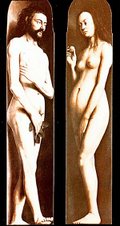
Fave Painting: Eden
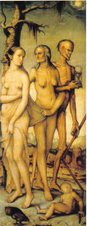
Fave Painting: The Three Ages of Man and Death
by Albrecht Dürer
From the First Chapter
The Secret of Hurricanes : That article in the Waterville Scout said it was Shake- spearean, all that fatalism that guides the Kennedys' lives. The likelihood of untimely death. Recently, another one died in his prime, John-John in an airplane. Not long before that, Bobby's boy. While playing football at high speeds on snow skis. Those Kennedys take some crazy chances. I prefer my own easy ways. Which isn't to say my life hasn't been Shake-spearean. By the time I was sixteen, my life was like the darkened stage at the end of Hamlet or Macbeth. All littered with corpses and treachery.
My Original Artwork: Triptych
Wishing
Little Deer
Transformation
Looking Forward, Looking Back
CURRENT MOON
Labels
- adolescence (1)
- Airstream (7)
- Alain de Botton (1)
- all nighters (2)
- Allen (1)
- altars (1)
- Angelus Silesius (2)
- animals (1)
- Annie Dillard (1)
- Antonio Machado (2)
- AOL Redux (1)
- April Fool (1)
- Archibald MacLeish (1)
- arts and crafts (55)
- Auden (1)
- awards (2)
- AWP (2)
- Bach (1)
- Basho (5)
- Beauty and the Beast (1)
- birthdays (1)
- blogs (5)
- boats (2)
- body (2)
- books (7)
- bookstores (1)
- Buddha (1)
- Buddha's Little Instruction Book (2)
- butterfly (4)
- buzzard (2)
- Capote (4)
- Carmel (1)
- Carson McCullers (1)
- cats (15)
- Charles Bukowski (1)
- Charles Simic (2)
- Christina Georgina Rossetti (1)
- church (2)
- confession (1)
- Conrad Aiken (1)
- cooking (5)
- crows (1)
- current events (2)
- D. H. Lawrence (3)
- death (6)
- Delmore Schwartz (4)
- detachment (1)
- dogs (7)
- domestic (3)
- dreams (21)
- Edward Munch (4)
- Edward Thomas (1)
- Eliot (3)
- Eliot's Waste Land (2)
- Emerson (2)
- Emily Dickinson (10)
- ephemera (1)
- Esalen (6)
- essay (3)
- Eugene O'Neill (3)
- Ezra Pound (1)
- F. Scott Fitzgerald (1)
- fairy tales (7)
- Fall (16)
- Famous Quotes (16)
- festivals (2)
- fire (5)
- Floreta (1)
- food (1)
- found notes etc. (1)
- found poem (2)
- fragments (86)
- Frida Kahlo (1)
- frogs-toads (4)
- Georg Trakl (1)
- gifts (1)
- Global Warming (1)
- Gluck (1)
- goats (1)
- Goodwill (1)
- Great lines of poetry (2)
- Haibun (15)
- haibun moleskine journal 2010 (2)
- Haiku (390)
- Hamlet (1)
- Hart Crane (4)
- Hayden Carruth (1)
- Henry Miller (1)
- holiday (12)
- Hyman Sobiloff (1)
- Icarus (1)
- ikkyu (5)
- Imagination (7)
- Ingmar Bergman (1)
- insect (2)
- inspiration (1)
- Issa (5)
- iTunes (1)
- Jack Kerouac (1)
- James Agee (2)
- James Dickey (5)
- James Wright (6)
- John Berryman (3)
- Joseph Campbell Meditation (2)
- journaling (1)
- Jung (1)
- Juniper Tree (1)
- Kafka (1)
- Lao Tzu (1)
- letters (1)
- light (1)
- Lorca (1)
- Lorine Niedecker (2)
- love (3)
- Lucille Clifton (1)
- Marco Polo Quarterly (1)
- Marianne Moore (1)
- Modern Poetry (14)
- moon (6)
- movies (20)
- Muriel Stuart (1)
- muse (3)
- music (8)
- Mystic (1)
- mythology (6)
- nature (3)
- New Yorker (2)
- Nietzsche (1)
- Northfork (2)
- November 12 (1)
- October (6)
- original artwork (21)
- original poem (53)
- Our Dog Buddha (6)
- Our Dog Sweet Pea (7)
- Our Yard (6)
- PAD 2009 (29)
- pad 2010 (30)
- Persephone (1)
- personal story (1)
- philosophy (1)
- Phoku (2)
- photographs (15)
- Picasso (2)
- Pilgrim at Tinker Creek (1)
- Pillow Book (5)
- Pinsky (2)
- plays (1)
- poem (11)
- poet-seeker (9)
- poet-seer (6)
- poetry (55)
- politics (1)
- poppies (2)
- presentations (1)
- Provincetown (51)
- Publications (new and forthcoming) (13)
- rain (4)
- Randall Jarrell (1)
- reading (6)
- recipes (1)
- Reciprocity (1)
- Richard Brautigan (3)
- Richard Wilbur (2)
- Rilke (5)
- river (5)
- river novel (1)
- rivers (12)
- Robert Frost (2)
- Robert Rauschenberg (1)
- Robert Sean Leonard (1)
- Robinson Jeffers (1)
- Rollo May (2)
- Rumi (1)
- Ryokan (1)
- Sexton (1)
- short stories (13)
- skeletons (2)
- sleet (1)
- snake (1)
- Snow (24)
- solitude (1)
- spider (2)
- spring (1)
- Stanley Kunitz (1)
- students (2)
- suffering (4)
- suicide (2)
- summer (20)
- Sylvia Plath (2)
- Talking Writing (1)
- Tao (3)
- teaching (32)
- television (4)
- the artist (2)
- The Bridge (3)
- The Letter Project (4)
- The Shining (1)
- Thelma and Louise (1)
- Theodore Roethke (16)
- Thomas Gospel (1)
- Thomas Hardy (1)
- toys (3)
- Transcendentalism (1)
- Trickster (2)
- Trudell (1)
- Ursula LeGuin (1)
- vacation (10)
- Vermont (6)
- Virginia Woolf (1)
- Vonnegut (2)
- Wallace Stevens (1)
- Walt Whitman (8)
- weather (7)
- website (3)
- what I'm reading (2)
- William Blake (2)
- William Butler Yeats (5)
- wind (3)
- wine (2)
- winter (24)
- wood (3)
- Writing (111)
- Zen (1)