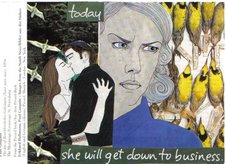
I've thought how to explain what the Provincetown Residency means to me. My ideas for how to express it seemed too shallow. Today, my eyes fell upon a Theodore Roethke poem. My good friend Roethke will help me to explain. His poem, "The Right Thing" speaks my inner thoughts today:
The Right Thing
by Theodore Roethke
Let others prove the mystery if they can.
Time-harried prisoners of Shall and Will--
The right thing happens to the happy man.
Yes, I have been that prisoner of "Shall" and "Will." I have let my brain be torn apart by fear and doubt. I have had a preconceived idea about what is "the right thing" for me. I have tried to second-guess life. This year when I filled out the application for the residency, I just told the truth and let the chips fall where they may. I wasn't nervous or afraid or lacking in confidence. I was calm and peaceful and confident. When I chose my writing sample, I didn't second-guess. I sent a recent story that is simple and true. In short, I was happy. The Provincetown Residency will be the vehicle for helping me to live in that place for an extended period of time. I won't find it and then be jerked out of it by obligations or other realities.
The bird flies out, the bird flies back again;
The hill becomes the valley, and is still;
Let others delve that mystery if they can.
I try too hard. Obligations take me out of my soul. The bird flies back to my soul. It is a rending, a tearing. Sometimes I think it will make me mad. One day I'm on a hill, confident, exuberant; then right behind that is the valley, doubts and darkness. But what if the hill and the valley were the same? What if there is no right or wrong; it is the same thing? It is all "right" if we accept that it is right, feel that.
As Yoda said, there is no try, only do. In that moment of doing, all is right.
God bless the roots!--Body and soul are one!
The small become the great, the great the small;
The right thing happens to the happy man.
Perfect balance.
Child of the dark, he can out leap the sun,
His being single, and that being all:
The right thing happens to the happy man.
Perfect balance.
Or he sits still, a solid figure when
The self-destructive shake the common wall;
Takes to himself what mystery he can,
Put the currency of the soul in the bank, so when you feel ready to give in to doubt and fear, you can plumb the mystery again of perfect balance.
And praising change as the slow night comes on,
Wills what he would, surrendering his will
Till mystery is no more: No more he can.
The right thing happens to the happy man.
Acceptance. Complete acceptance. Pure acceptance. Whether the slow night is doubt and fear or the passing of time towards mortality, you do your best. Make changes where you can, surrender you will when you cannot. It is not a mystery; just be. Find that true place. Live from there. Then you are happy. Everything, no matter what, is the right thing.
The Provincetown Residency will take me on this voyage, into the true place where everything is the right thing. What a gift.
Showing posts with label poet-seer. Show all posts
Showing posts with label poet-seer. Show all posts
Tuesday, April 29, 2008
Monday, November 12, 2007
On Nov. 12
On this day in 1935, 27-year-old Theodore Roethke was hospitalized for the first of the manic-depressive breakdowns that would recur throughout his life. Roethke had just begun a teaching post at Michigan State University and, according to colleagues, had been drinking heavily all semester, dozens of cups of coffee and bottles of cola a day as well as alcohol. On the previous evening, a cold one, he had taken a long walk in the woods without a coat and eventually with only one shoe; the next morning, after deciding "to cut my eight o'clock class deliberately just to see how long they would stick around," Roethke took another walk in the woods, also coatless. He was shivering and delirious when he arrived at the dean's office, where he planned "to explain one or two things about this experiment"; the dean, trained as a mathematician, called for the doctors. Roethke later told friends that while on his first walk he had had a mystical experience with a tree -- even pointed out the tree, while retrieving his shoe. The tree taught him "the secret of Nijinsky," he said, perhaps referring to that passage in Nijinsky's diary -- written while Nijinsky was a mental patient -- that describes learning from a tree that "human beings do not understand feelings."
Sunday, November 11, 2007
Emily Dickinson Dysfunction, Part I
A confession: I have trouble reading Emily Dickinson's poems.
My first encounter with her was probably high school, probably, "I'm nobody, who are you?"
In college, her Complete Poems in my hand, I convinced myself I was indifferent to her work. More likely I didn't like the feeling of being trapped in the corridors of her mind.
Whitman was a different story: "I depart as air," he wrote.
I longed for a transcendent experience like Whitman's; I still do. Whitman gave me hope of shedding this mortal coil. Dickinson did not. Her isolation, her "madness," her constant tracings of mind-shifts, the volatile underpinnings of her seemingly quiet existance were all things I did not want for myself.
More to come.
My first encounter with her was probably high school, probably, "I'm nobody, who are you?"
In college, her Complete Poems in my hand, I convinced myself I was indifferent to her work. More likely I didn't like the feeling of being trapped in the corridors of her mind.
Whitman was a different story: "I depart as air," he wrote.
I longed for a transcendent experience like Whitman's; I still do. Whitman gave me hope of shedding this mortal coil. Dickinson did not. Her isolation, her "madness," her constant tracings of mind-shifts, the volatile underpinnings of her seemingly quiet existance were all things I did not want for myself.
More to come.
Sunday, August 05, 2007
Bridge Collapse-part 2
After looking at the comments I received on my first entry about the bridge collapse and after listening tonight to some tapes about Langston Hughes and Wallace Stevens, I finally have something to say about meaning.
I have never been afraid to cross bridges. Of course, it goes through my mind, "What if," every time I'm on a bridge. But then I calm and trust everything will be fine.
For many years, I was trusting. I took people at their word, and I trusted that the people who designed bridges knew what they were doing and had my best interests in mind. The same with leaders, people in authority, like teachers and doctors.
You live and learn. Slowly my trust began to crumble and erode. Now I fight cynicism almost every day. There's plenty to be cynical about, but I don't like feeling that way. It really bothers me. I hate it.
I've built many bridges in this life. I've tried to make meaningful connections the best way I could.
If one of my bridges should collapse, I have others. Hart Crane saw the bridge as Faustian, as a symbol of human intelligence, ability, and power, but bridges aren't forever.
Listening to the lives of poets on my tapes, I was reminded of how poets of that time were influenced by the philosopher William James.
How do we make meaning? What happens when we have the will to believe and nothing to believe in?
There are no large solutions. Truth is momentary.
I have never been afraid to cross bridges. Of course, it goes through my mind, "What if," every time I'm on a bridge. But then I calm and trust everything will be fine.
For many years, I was trusting. I took people at their word, and I trusted that the people who designed bridges knew what they were doing and had my best interests in mind. The same with leaders, people in authority, like teachers and doctors.
You live and learn. Slowly my trust began to crumble and erode. Now I fight cynicism almost every day. There's plenty to be cynical about, but I don't like feeling that way. It really bothers me. I hate it.
I've built many bridges in this life. I've tried to make meaningful connections the best way I could.
If one of my bridges should collapse, I have others. Hart Crane saw the bridge as Faustian, as a symbol of human intelligence, ability, and power, but bridges aren't forever.
Listening to the lives of poets on my tapes, I was reminded of how poets of that time were influenced by the philosopher William James.
How do we make meaning? What happens when we have the will to believe and nothing to believe in?
There are no large solutions. Truth is momentary.
Sunday, June 24, 2007
I Am With You

This is my favorite portrait of Walt Whitman. This Walt Whitman is not the "good gray poet" we are taught about in school. This portrait is sometimes called his "Christ" portrait, and one can see why. There is serenity in this portrait and Whitman looks deeply spiritual. That calm gaze penetrates you, knows you, exudes compassion. It's hard to look away. But Whitman was also a man of contradictions, and he himself warned that he wasn't the good-natured, easy friend we might suppose him to be:
Are you the new person drawn toward me, and asking something significant of me? / Do you think it so easy to have me become your lover? / Do you suppose I am trusty and faithful? / Do you see no further than this facade--this smooth and tolerant manner of me?
There's much about Whitman that has the capability to offend, but that is what makes reading him so delicious. To understand Whitman, we must have learned to understand paradox and contradiction. To understand Whitman, we have to be able to relish life's questions. Whitman's poetry was dangerous when it was written and it's dangerous now, and that's why I love it. It is non-conformist in every way. To read and to understand a Whitman poem is to become potentially dangerous yourself, and I like the edginess of that. One of the things I most love about Walt Whitman is his affection for his unseen reader, which is palpable in his poems "Song of Myself," "I Sing the Body Electric," "Song of the Open Road," and, my favorite, "Crossing Brooklyn Ferry":
I am with you, you men and women of a generation, or ever so many generations hence, / I project myself, also I return--I am with you, and you know how it is.
What is so beautiful about this, for me, is that Whitman transcends time and place and at the same time he renews my belief that being a writer is an important thing, a life-affirming thing. His presence is so real as I read his poems that I can feel his breath stirring my hair or warming the back of my neck. Whitman's poetry was not very popular in his own time, and excepting Hart Crane's work, Whitman's influence was not what I would call huge for the first half of the 20th Century. Whitman came to power in the 1950s and 1060s with the Beats who loved those long lines of free verse, the sexual freedom in the lines, the expansion and the movement in the lines which Kerouac would act out in writing On The Road. By the 1970s, when I did my undergraduate work, Walt Whitman was a necessary part of the literature curriculum, though somewhat of an ill fit for post-Watergate times. I remember that the cynicism of that decade made it difficult for me to connect with Whitman's poems and yet I saved my lumpy battered copy of Leaves of Grass, and I still have that college copy, although it got soaked when Allen accidentally drove into a swamp and flooded the whole bottom of our car. I knew the poems were important; I just didn't know how to understand them. To explicate a Whitman poem line by line is to destroy the spirit and life of the poem. But explication was what I did best in those days.
I think Whitman is a poet you must come to several times throughout your life. You must keep a copy of Leaves of Grass on hand and you must take it off the shelf and dust it off and read it now and again. You have to let the poems penetrate you like Whitman's eyes penetrate you in that portrait. When you do that, you can feel the divinity of everything. I've read Whitman enough at this point in my life that I do feel he is with me. As I think about it, I live in cynical times now. But something about me has changed enough to let Walt Whitman in. I've long ago given up on absolutes, and I'm not that naive young wife and mother who believed everything in my life would turn out just great because I was doing what I was "supposed" to and so I somehow deserved success. In fact, my whole idea of success was different then, more mainstream. Now I work to define success in a way that makes sense for me. This has broadened my concept of what it means to embrace life. It is as Isaac Gewirtz says of Whitman, that he had an authentic experience of the cosmos "and all that it contains--rivers, clouds, stars, animals, cruelty, compassion, and, especially, his own and other soul/bodies journeying down the open road." To me life is about his kind of realization, this kind of connection.
I bought a little jewelry box at the Goodwill yesterday for a dollar. I want to make an art box out of it and call it my Whitman Box.
Saturday, September 16, 2006
Mysticism and Scholarship
Part of my task as a writer has been to integrate my inclination toward the sacred, toward mysticism, with my scholarly pursuits. I've always felt a little off kilter in academic environments which are more than a little left-brained and practical. It leaves me feeling a bit like a "flake," sometimes, and I don't like feeling that way. Like the novelist Edith Wharton, who was born the same day of the month that I was, I've always had the need to be taken seriously by my peers and especially my colleagues at the university. My reputation, my very future at the university, is dependant on their respect for what I do.
This search for integration has led me to a book written at the turn of the century by a mystic and scholar, Rudolf Steiner. In Mystics After Modernism, Steiner discusses Meister Eckhart, Johannes Tauler, Heinrich Suso, Jan Van Ruysbroeck, Nicholas of Cusa, Agrippa of Nettesheim, Paracelsus, Valentin Weigel, Jacob Boehme, Giordano Bruno, and Angelus Silesius.
The foreword, by Christopher Bamford, is enlightening. Bamford discusses how a certain kind of listening can lead us to "become what we know." This knowledge, this becoming, according to Bamford, "is not a little self, but a self that is ultimately one with the universe."
For some, the contemplative seems shut off from the world, yet Steiner says that "What takes place in our inner life is not a mere [private] mental repetition, but a real part of the universal process."
For the mystic, the divine isn't something external to be repeated within; it is "something real in them to be awakened," says Bamford.
Angelus Silesius put it this way: "I know without me God cannot live for a moment; if I were to come to naught, God would have to give up the ghost. ... God cannot make a single worm without me; if I do not preserve it with God, it would fall apart immediately."
Bamford ends with the statement: "In fact, the world is falling apart, and it is up to us to preserve it."
Two things present themselves from this present exploration:
1) Silesius is talking about a kind of reciprocity not unlike Lao Tzu's.
2) My writing life is my vehicle of awakening and my mode of reciprocity. If the world is falling apart, as Bamford suggests, maybe it's through writing that I do my part to preserve it.
This search for integration has led me to a book written at the turn of the century by a mystic and scholar, Rudolf Steiner. In Mystics After Modernism, Steiner discusses Meister Eckhart, Johannes Tauler, Heinrich Suso, Jan Van Ruysbroeck, Nicholas of Cusa, Agrippa of Nettesheim, Paracelsus, Valentin Weigel, Jacob Boehme, Giordano Bruno, and Angelus Silesius.
The foreword, by Christopher Bamford, is enlightening. Bamford discusses how a certain kind of listening can lead us to "become what we know." This knowledge, this becoming, according to Bamford, "is not a little self, but a self that is ultimately one with the universe."
For some, the contemplative seems shut off from the world, yet Steiner says that "What takes place in our inner life is not a mere [private] mental repetition, but a real part of the universal process."
For the mystic, the divine isn't something external to be repeated within; it is "something real in them to be awakened," says Bamford.
Angelus Silesius put it this way: "I know without me God cannot live for a moment; if I were to come to naught, God would have to give up the ghost. ... God cannot make a single worm without me; if I do not preserve it with God, it would fall apart immediately."
Bamford ends with the statement: "In fact, the world is falling apart, and it is up to us to preserve it."
Two things present themselves from this present exploration:
1) Silesius is talking about a kind of reciprocity not unlike Lao Tzu's.
2) My writing life is my vehicle of awakening and my mode of reciprocity. If the world is falling apart, as Bamford suggests, maybe it's through writing that I do my part to preserve it.


Subscribe to:
Posts (Atom)
Subscribe To


 Posts
All Comments
Posts
All Comments
Dreaming
About Me
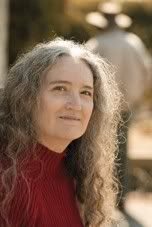
- Theresa Williams
- Northwest Ohio, United States
- "I was no better than dust, yet you cannot replace me. . . Take the soft dust in your hand--does it stir: does it sing? Has it lips and a heart? Does it open its eyes to the sun? Does it run, does it dream, does it burn with a secret, or tremble In terror of death? Or ache with tremendous decisions?. . ." --Conrad Aiken
Facebook Badge

Subscribe
Posts
All Comments
Fave Painting: Eden
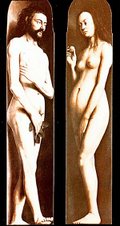
Fave Painting: The Three Ages of Man and Death
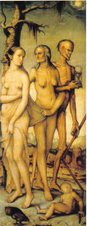
by Albrecht Dürer
My Original Artwork: Triptych
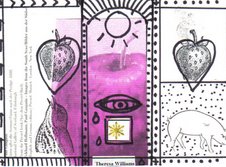
Wishing
Little Deer
Transformation

Looking Forward, Looking Back