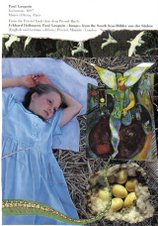
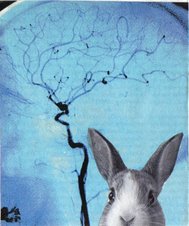
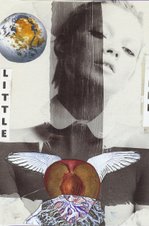
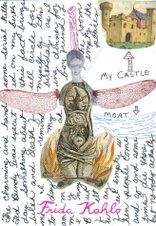
Photo: Portrait of John Berryman on dust cover of Modern Critical Views. In the background, Mistress Bradstreet.
The Spring Semester starts tomorrow. I've taught now going on 22 years if you count the time I taught as a graduate assistant at East Carolina University and graduate fellow at BGSU. I still start each semester with a sense of optimism mixed with apprehension. Next semester will bring with it new challenges and opportunities.
Today marks a strange anniversary: On this day in 1972, John Berryman committed suicide by walking off a bridge spanning the Mississippi River. I spent much of Winter Break reading about Berryman. One of the greatest books I read was Poets in Their Youth by Eileen Simpson. Simpson was Berryman's first wife. She writes of Berryman, her life with him, and other writers of that generation with such perception and grace, notwithstanding the personal pain she must have gone through as the wife of a flawed and driven man. She doesn't dwell on herself; instead, she paints a vivid picture of John Berryman, Robert Lowell, Jean Stafford, Delmore Schwartz, and Randall Jarrell, among others.
Eileen Simpson studied psychology during the last years of her marriage with Berryman and later became a psychologist. Her observations are always compassionate and thoughtful. One of the saddest things she talked about was Delmore Schwartz's death, how the once-handsome and awesome poet died in agony in a flea bag motel clutching his heart for hours before he was finally taken to a hospital, where he died. His body wasn't claimed for two days. Schwartz, like Berryman, Lowell, Stafford, and Jarrell, had some form of mental illness, such as depression or bi-polar disorder. Their agony survives in their work.
Literary critics have speculated that Berryman's writing took him to places that were too dark for him to survive. In contrast to these critics, Simpson, at the end of her book, says that it was writing that kept her husband alive for so long.
I dwell here on Berryman so long because he will play a prominent role in the seminar I'm teaching, FROM ANGST TO ART. We are going to be studying how various artists took the raw and bitter material from their lives and spun it into art. Berryman's generation had a particularly difficult time because they wrote in the shadow of the Moderns, such as Ezra Pound and T. S. Eliot. It was quite a struggle for them to break with these marble statues and to write intensely personal poetry.
Eileen Simpson's description of Berryman working on his poem about Mistress Bradstreet is both harrowing and inspirational. In that poem, Berryman finally broke away from the Moderns and it was truly like a new birth for him:
Monster you are killing me Be sure
I'll have you later Women do endure
I can can no longer
and it passes the wretched trap whelming and I am me
drencht & powerful, I did it with my body!
I ended up cutting a lot out of the seminar. I always start out much too optimistic about what can be achieved in 16-weeks! But Berryman I could not cut; in fact, I ended up getting more interested in him than I should have: I should have been working harder on my James Wright project which I hope to present to the class!
All right, tomorrow it all starts again. Here I go!
The Spring Semester starts tomorrow. I've taught now going on 22 years if you count the time I taught as a graduate assistant at East Carolina University and graduate fellow at BGSU. I still start each semester with a sense of optimism mixed with apprehension. Next semester will bring with it new challenges and opportunities.
Today marks a strange anniversary: On this day in 1972, John Berryman committed suicide by walking off a bridge spanning the Mississippi River. I spent much of Winter Break reading about Berryman. One of the greatest books I read was Poets in Their Youth by Eileen Simpson. Simpson was Berryman's first wife. She writes of Berryman, her life with him, and other writers of that generation with such perception and grace, notwithstanding the personal pain she must have gone through as the wife of a flawed and driven man. She doesn't dwell on herself; instead, she paints a vivid picture of John Berryman, Robert Lowell, Jean Stafford, Delmore Schwartz, and Randall Jarrell, among others.
Eileen Simpson studied psychology during the last years of her marriage with Berryman and later became a psychologist. Her observations are always compassionate and thoughtful. One of the saddest things she talked about was Delmore Schwartz's death, how the once-handsome and awesome poet died in agony in a flea bag motel clutching his heart for hours before he was finally taken to a hospital, where he died. His body wasn't claimed for two days. Schwartz, like Berryman, Lowell, Stafford, and Jarrell, had some form of mental illness, such as depression or bi-polar disorder. Their agony survives in their work.
Literary critics have speculated that Berryman's writing took him to places that were too dark for him to survive. In contrast to these critics, Simpson, at the end of her book, says that it was writing that kept her husband alive for so long.
I dwell here on Berryman so long because he will play a prominent role in the seminar I'm teaching, FROM ANGST TO ART. We are going to be studying how various artists took the raw and bitter material from their lives and spun it into art. Berryman's generation had a particularly difficult time because they wrote in the shadow of the Moderns, such as Ezra Pound and T. S. Eliot. It was quite a struggle for them to break with these marble statues and to write intensely personal poetry.
Eileen Simpson's description of Berryman working on his poem about Mistress Bradstreet is both harrowing and inspirational. In that poem, Berryman finally broke away from the Moderns and it was truly like a new birth for him:
Monster you are killing me Be sure
I'll have you later Women do endure
I can can no longer
and it passes the wretched trap whelming and I am me
drencht & powerful, I did it with my body!
I ended up cutting a lot out of the seminar. I always start out much too optimistic about what can be achieved in 16-weeks! But Berryman I could not cut; in fact, I ended up getting more interested in him than I should have: I should have been working harder on my James Wright project which I hope to present to the class!
All right, tomorrow it all starts again. Here I go!




 Posts
Posts