Showing posts with label mythology. Show all posts

Wednesday, August 09, 2006

Generations


Photobucket - Video and Image Hosting


Photo: Durga gives her grandmother the stolen guava.


Those of you who used to visit me at the old AOL Journal may remember I did some entries on fairytales and myths, including Thumbelina and Persephone. Those stories have become very central in my thinking about how to tell women's stories. I finished a story this summer that somewhat draws from archetypes present in Thumbelina and Persephone. I'm working on another that also draws from the same archetypes. I think one of the breakthroughs writers make is when they recognize these ancient patterns in modern life.

As I worked on this latest story, I couldn't help thinking about a favorite movie of mine, Pather Panchali, which is no longer available to buy at Amazon, unfortunately, but which can be rented pretty easily enough.


I've read several reviews of Pather Panchali, and not one really talks about the women in the film to my satisfaction, so I hope to do that here as a way of emphasizing the Maiden/Mother/Crone archetype. Most of the reviews I've seen call Durga (the "maiden") a petty thief. I disagree, and here is my take on the movie. I've canabalized from my Amazon review. I do those from time to time, as a "no pressure way "to sharpen the critical skills.

Reviews generally focus on the main character, Apu, yet Pather Panchali is also a powerful portrayal of various phases of women's lives: maiden, mother, and crone.

Durga, the maiden, is often described as a petty thief, yet her acts often seem heroic to me and serve to underscore the pettiness and selfishness of her neighbors. Durga steals guavas and also a set of beads. Why should Durga have to steal guavas from the land that used to belong to her father? Why can't the neighbors share? They know the family is struggling with everyday survival. Does Durga eat the guavas herself? No, she gives them to her grandmother.

As for stealing the beads, Durga's desire for something pretty, while not so heroic, is perfectly understandable when one takes into account how little Durga is appreciated in a family that dotes on Apu, the boy. Yet there are no villains in this movie. All characters are fully rounded. The mother, who often seems cruel, is also a sympathetic character who tries to keep her pride in tact while descending deeper into poverty all the time.

(In fact, Durga's mother also "steals" a guava. This happens much later in the movie and suggests to me that the mother now understands the maiden's motivation for "stealing" the guavas: love).

The grandmother (Crone) is, to me, the best character in the whole movie. She's as mysterious as she is mischevious. The petty bickering between Durga's mother and grandmother doesn't show an absence of love but results from the pressures of day to day survival. The women, in fact, are woven into the same tapestry of life. In one brilliant shot, the mother is shown holding her weary back while the grandmother, bent from years of hardship and work, shuffles in the background. Life is hard and the inevitability of old age is just around the corner. How is one's hard work and sacrifice repaid? Are we destined to end up like Durga's grandmother, whom nobody seems to want? Nobody, save Durga, who has a pure heart and shows her love by bringing lovingly her hungry grandmother stolen guavas.

Yes, this is the story of Apu, a young boy, but it's also the story of the three main phases of women's lives.

Remembering ancient patterns of storytelling have become invaluable to me. These patterns exist deep within our psyche, and readers will recogize them when they read your stories.

Friday, April 21, 2006

Giving Credit to the Muse

Beyond the Pale. Artist, Anthony Weir.


For the longest time, I had trouble understanding the concept of a muse. I thought about it as something a little bit ridiculous, too romantic for me. I pictured a love-sick poet soaking his writing page with tears, pining for his lover.

Then one day it hit me: a muse is anything or anyone that drives you to create. I think my muse is constantly changing, and my muses are writers of the past. James Wright, Truman Capote, James Dickey, Edith Wharton, James Agee, and so on. And you have to give credit to the muse, because nobody writes in a vacuum. Nobody goes it alone. And if you don't give credit to your muse, your work dries up.

I'm reminded of a Native American Trickster Tale:

Coyote was hungry and cold. He wrapped himself in a blanket and went to talk to Stone, who had magical powers. "Stone," he said. "I am starving to death. If you help me, I will give you my blanket." Coyote placed his blanket across Stone.

As Coyote walked home, he saw a deer and he killed it with his first arrow. "Oh boy," Coyote said. "That was lucky." Then he thought of Stone and was thankful.

A few moments later, Coyote began to feel very cold. "Stones do not need a blanket," Coyote said to himself. "And anyway, I killed the deer myself. Stone had nothing to do with it."

Coyote returned to Stone and took his blanket. But when he returned to his camp, he saw the deer had turned to dust. Only magic could have done such a thing to the deer.

Coyote thought about it. Then he said to himself, "I know where I made my mistake." Coyote held his blanket tightly around himself, shivering from the cold and weak from hunger. He thought, "I should have eaten the deer first, THEN took my blanket away from Stone."

Coyote went back on his promise. He lost his connection to what is right. And he failed to give proper thanks to the magical source that helped to nourish him. As a result, his nourishment turned to dust.

I think it would be the same for me if I failed to properly acknowledge my muses.

Today in my Native American Literature class, the students were doing presentations. Their presentations took many forms. One by one, the presenters came before the class, sat in a chair, and shared part of themselves and what the literature had taught them. One student had written a song. She played her guitar and sang. Her arm flew out and then came back with great force to pluck the strings. She closed her eyes and her voice was strong and sweet.

Another student put on dark glasses and read parts of a journal he had started during the semester. The entries were fragmented and painful for him to read. They were based on a fall he had experienced, a fall into the void of clinical depression. Because the literature we read this semester is a literature of survival, he had identified strongly with it. The literature had helped to draw out his dark thoughts, like the chewing tobacco my Daddy used to put on my bee stings used to draw out the poison.

Another student read his own poems. Another had painted a picture for the first time in many years. She smiled shyly and claimed she had no talent and wasn't "creative in any way." Another, a philosophy major, talked of how his classes had converged this semester to bring him to a new state of consciousness.

It was a beautiful experience, but I don't take credit for any of this. The authors we studied were the students' muses.

And they gave proper thanks. Yes they did.

Saturday, March 25, 2006

Do You Like Flowers?

My Collage: Flowers, based on Frida Kahlo's My Nurse and I. (I wanted to focus on the nurturing, regenerative, and spiritual power of flowers.)


This is the time of year when people starting thinking about flowers. And who doesn't like flowers?

Yet I wasn't born with an appreciation for flowers. Or maybe it's that I grew up in the South, where flowers are almost perpetual. My mother loved flowers and grew them in profusion. Maybe I was spoiled by too many.

Whatever the reason, I was neutral about flowers for a long, long time.

In art school, for instance, I couldn't understand why anybody would want to paint flowers. I was not interested in Van Gogh's sunflowers in the least. O'Keefe's flowers? I didn't understand what the fuss was about.

The first time I can remember caring about flowers was after the birth of our third son. I knew he would be my last, and I felt sad about that. Each time I had loved the feeling of being pregnant and loved the act of giving birth. Allen knew this. He brought me a dozen red roses while I was in the hospital. It was the first flower bouquet he'd ever given me. I took them home and nurtured them almost as much as I did the baby. Watching them die made me unbearably sad. For a long time, I thought I'd loved the flowers only because of the association between them and my husband and son. So therefore that incident in itself didn't translate into a lifelong love of flowers.

When I first started developing a love of mythology, I began to realize how important flowers are as symbols. In so many fairytales and myths, flowers are symbolic of the soul. I think I started to appreciate them more as I saw how important they have been to storytellers through the ages.

I can't say there was one day or one incident I can point to, but one day I realized I'd fallen in love with flowers. Maybe it's the long, dark, cold winters in Ohio. Seeing flowers coming up through the still-frozen ground in the spring means something now. And in the summer, when I watch the bees tumbling in the pollen, I get an unbearable lump in my throat: it is so beautiful to watch, so erotic. In those moments, I can't help but think of O'Keefe's flowers, and I also know what she must have seen in her flowers, the ones she painted. Now, when I look at Van Gogh's works, I understand his passion for the hearty sunflowers.

When did it happen? When did looking into the trembling throat of a flower begin to fill me with such unbearable joy and pain?

I say pain, but it is a beautiful pain.

Tuesday, March 21, 2006

Confessional


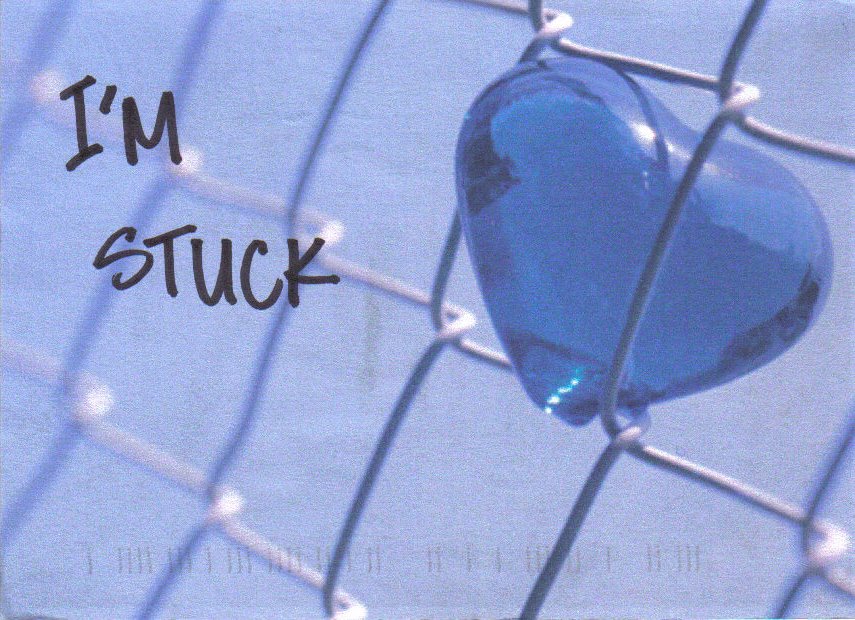
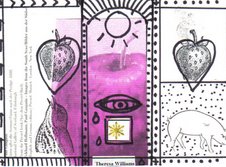
ARTIST: ANONYMOUS


I am excited.

I received my first postcard on 3/20/06.

A couple of entries ago, I invited any and all readers of this blog to send me a postcard which confesses a "secret." I also invited readers on my Yahoo Esalen group to do the same. This project of mine is based on Post Secret. However, my project is different. The secret need not be your own. The secret on your post card could even be entirely fictional. The only requirement is that the secret should be "true" in some way that matters to you.

Isn't this postcard excellent? The artist's image is pasted over the top of a postcard of the Grand Canyon. The description on the address-side of the card mentions "Years of the Colorado River's erosive power." When I saw that, I thought perhaps this was a subtle message, a way to suggest that the artist feels eroded by time and by some powerful force outside the artist's control.

The idea of being "stuck" is an important one for storytellers. As Joseph Campbell has pointed out, in fairytales, we often encounter a hero who is stuck, unable to move into the next phase of her or his life. Thumbelina is stuck in maidenhood until the ugly toad steals her from her mother's watch and takes her down, down, down into the muck of life. For Persephone, it is the same. Like Little Red Riding Hood, Persephone strays from her regular life long enough to pick flowers. Persephone is snatched away by Hades and becomes Queen of the underworld. Little Red encounters the wolf, gets swallowed by him, and then is reborn, quite literally, in fact, when ejected from of the wolf's belly.

In modern storytelling, the character is often stuck. The character then makes a choice to change her or his life. Or something happens to make the character have to make a choice. In academic circles, we call this second kind of story "the bear at the door." You simply can't remain stuck when the bear is clawing at your door about to break it down. You have to do SOMETHING.

I hope that more people will send me one or more postcards. You can send the postcards to:

Theresa Williams
Department of English
Bowling Green State University
Bowling Green, OH 43403

Thursday, February 09, 2006

Exile

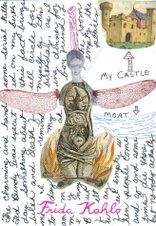
My collage: My Castle

This is a collage I have needed and wanted to do for a long time. I mentioned to Judith Heartsong many months ago that I'd started on a collage about my healing from my surgery of 2002. I told her that I needed to finish it (she has been an inspiration to me and has given me the courage to express myself through visual art once again). I never did finish that collage I spoke to Judi about; but this one is perhaps better at expressing my feelings.

My Castle isn't based on a particular piece of Kahlo's artwork, but it is done on a card with biographical information about Frida Kahlo on one side and her signature (plus a drawing of her head and shoulders) on the other. My Frida has no arms or legs and she is being burned at the stake. She has wings, but she cannot fly. (Think of an insect that has been tortured by a cruel child.)

I have titled this post "Exile," and if you go through my AOL Journal, you will find at least three entries on the subject of exile. This is because I have begun to see life as a series of "Falls" from one state of being into another state of being. This fall is very painful. For a while, the loss of "paradise" is almost intolerable. That is what this collage represents; the feeling of helplessness resulting from being exiled from one's "castle" (self).

Exile, in days of old, was no small matter. To be locked out of the castle and cast out beyond the walls of the city meant certain death. Of course, modern life has its own forms of exile. Nothing, to me, is more frightening than exile.

Christina asked a question in her comment to my former post: why do I return to Gauguin again and again for my imagery? I think it is because his paintings represent an attempt to find paradise, to find wholeness, and that is what my life search is about, trying to find wholeness. Erin also mentioned in her recent post something about the changes she is noticing in herself, in the way she sees the world. She wants to embrace these changes, yet at the same time she mourns what she has lost: she mourns "the fall."

The reason this collage is so disturbing is that my Frida has been deprived of her arms and legs. She is missing her hands which express compassion and grace and also help her to complete her creative mission; she is missing her feet, through which the soul enters and leaves the body. Her organs are exposed. Anybody who has ever had an operation will relate to the feeling of being invaded, exposed.

Yes, this Frida is in real trouble. She is exiled from her castle and is burning at the stake. The writing on the postcard is from a story I wrote about my surgery. This is how I felt: like this burning Frida.

*Important: I am okay now. I am healthy and am on track both physically and emotionally. I am dedicating myself to my creative life with even more passion than I did before my operation. So everything is good!

Tuesday, January 03, 2006

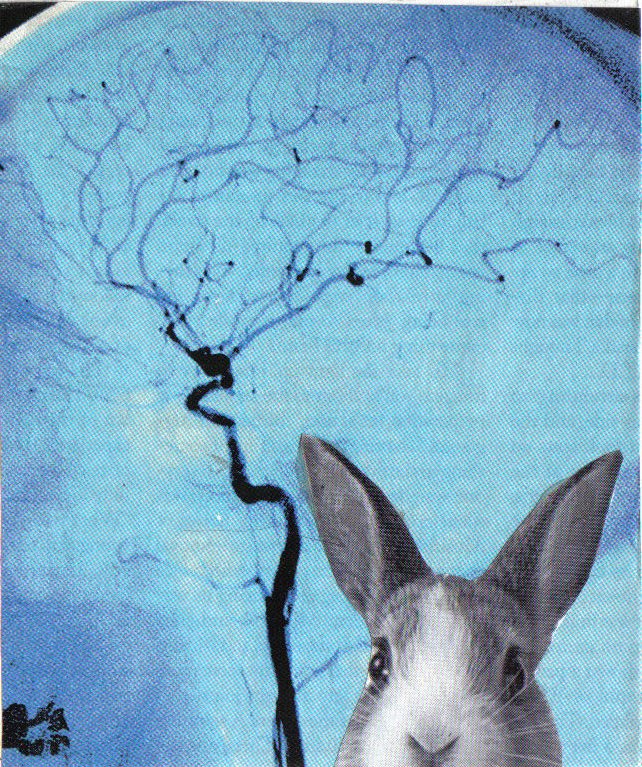
The Rabbit Tree


Top image: Paul Gauguin. Untitled (Tahitian landscape) of the artist's book, aus dem Kunstlerbuch Noa Noa Musee du Louvre, Paris.

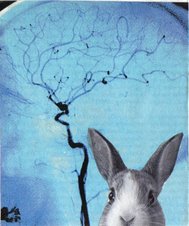
Bottom image: My collage, The Rabbit Tree, based on Gauguin's painting.

~~~~~~~~~~~~~~~~~~~~~~~~

I was getting tired of the old walls on my blog. Thought I'd slap some bright pink over everything and make a new start. What do y'all think? Is it too much?

I've managed to do a couple of collages since I got out of school for Christmas break. I did this collage, The Rabbit Tree, just before Christmas. I'm still working with Gauguin imagery. Earlier in the month, I had been researching the symbolism of trees. It seemed an apt thing to do with Christmas right around the corner and Cynthia writing about the importance of the Christmas tree in her family.

I didn't know what I wanted to do with my collage until I ran across the mysterious image of the human brain that looks very much like a tree to me. My son's is an illness of the brain, so that image really spoke to me. The cool colors and the starkness of the image mirrored my psyche. When I am stressed or undergoing some dramatic change in my life, I go back to the fundamental question of "Who am I?" That is when I thought about a rabbit.

Once, about two years ago, I asked my husband, Allen, what animal I most reminded him of. He thought for a while and then said, "A rabbit." At first I was indignant: A rabbit? That cute, timid, insignificant, cuddly thing of Easter baskets? Is that how he really thinks of me? I wondered. I said something to him to that effect.

"No, no!" he countered. "That's not how I think of rabbits. Rabbits are quiet, patient, strong creatures who survive underground, in the deep places in the earth. That's where you live, in the deep places of your heart." Needless to say, I thought that was a fantastic answer and further evidence to me that I'd married just the right man.

So, off to do research about the rabbit and the hare! What a fascinating creature in many mythologies. In one Native American culture, for instance, the hare stories are very sacred, the hare representing their Christ. Indeed, when the missionaries came, the indigenous peoples said they didn't need Christ, for they already had hare. The hare was also closely associated, in some cultures, to the moon and to healing, to the stars. So when Spring came, with its thaw, with its rains and its flooding, I wrote a poem to the rabbit. The poem is rough and unfinished, but it encapsulates my thinking during that time.

Looking at the stark image of the brain, reflecting on what my son was going through, I began to think of myself again as that rabbit, living in the dark places of my psyche, gathering food, gathering healing herbs, gathering strength for the days ahead. The rabbit, then, finished off my collage image well.

Here is the poem I wrote about the rabbit:

Moon-Hare
In this wet season
rain
claws your burrow
with its sharp nails.

I look out my window
and see you sniffing
the ground at the edge
of the blue, fallow field.

March-Hare,
Are you flooded out?
Soon, Osiris will gather
himself again. This rain
will stop.

You
will
go
home
again.

Watching you, I wonder, Has
your winter shyness given way
to the rutting madness of your mates?
Or do you prefer to crouch
at the Virgin's feet? I'd give a house-full
of coppers to know myself again. I yearn
for bucks all my own, their rutting ways.

Rough-Footed Lepus,
Osiris' Boat,
sniffing among the dead grasses,
once a year, gods say you lay
your eggs in our secret places.

Your likeness is everywhere
this time of year: Gingham, pink,
or chocolate-brown,
you ride in children's baskets.

Basket-rider, sawdust-filled companion,
sweet-tooth cure, you once fought
monsters, stood between us and the Great
Manitou. But we've forgotten that.

Moon-Hare, Savior.
You sacrificed your immature ways
for the sake of further development,
and for that you are our Christ.

I watch you, Moon-Hare.
You leap toward the cottonwoods.
I have no fig-tree you can pound
your herbs beneath to make your
magic drink.

I wish I had such a tree.
I would ask you to make a drink for me.

Dreaming

Dreaming

About Me

My photo
Northwest Ohio, United States
"I was no better than dust, yet you cannot replace me. . . Take the soft dust in your hand--does it stir: does it sing? Has it lips and a heart? Does it open its eyes to the sun? Does it run, does it dream, does it burn with a secret, or tremble In terror of death? Or ache with tremendous decisions?. . ." --Conrad Aiken

Followers

Search This Blog

Epistle, by Archibald MacLeish

What I'm Listening To

My Music

Great Artists

www.flickr.com
This is a Flickr badge showing public photos from theresarrt7. Make your own badge here.

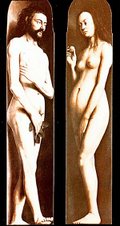
Fave Painting: Eden

Fave Painting:  Eden

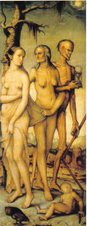
Fave Painting: The Three Ages of Man and Death

Fave Painting:  The Three Ages of Man and Death
by Albrecht Dürer

From the First Chapter

The Secret of Hurricanes : That article in the Waterville Scout said it was Shake- spearean, all that fatalism that guides the Kennedys' lives. The likelihood of untimely death. Recently, another one died in his prime, John-John in an airplane. Not long before that, Bobby's boy. While playing football at high speeds on snow skis. Those Kennedys take some crazy chances. I prefer my own easy ways. Which isn't to say my life hasn't been Shake-spearean. By the time I was sixteen, my life was like the darkened stage at the end of Hamlet or Macbeth. All littered with corpses and treachery.

My Original Artwork: Triptych

My Original Artwork:  Triptych

Wishing

Wishing

Little Deer

Little Deer

Transformation

Transformation

Looking Forward, Looking Back

Looking Forward, Looking Back
CURRENT MOON
Powered By Blogger

Labels