Friday, April 14, 2006

Northfork

Nick Nolte stars as Father Harlan, in Northfork. Here, he bears witness to young Irwin's death.

Northfork is a magical film about the death of a town and the death of young Irwin, an angel, according to Father Harlan.

Today in my Native American Literature class, we read aloud two essays by Native-American Linda Hogan, from her book of essays called Dwellings. One essay, "Stories of Water" is about the creative and destructive force of water and how humbling it is to be in the presence of such power.

Reflecting on the class later, as I'm prone to do, I remembered Northfork. The film is named for the town, which is to be flooded, lost to technological progress. As the town nears extinction, so does an orphan boy, named Irwin, who, as he slips toward death, has the most precious dreams.

At the end of the film, Father Harlan expresses his sorrow and his acceptance of life's pain. As Hogan speaks of being humbled by earth's power, Father Harlan speaks of being humbled in the presence of death. The impending death of the town, the death of Irwin. Water will cover all. There's something truly Biblical about the story. Nolte's voice is strong and quiet. It cracks with age, but he doesn't sound old. He's saintlike, but also profoundly human. He sounds almost timeless.

Northfork and Dwellings are both works to transport the soul.

Father Harlan: "And in that journey of dying, you see many things. But all of the issues I had are past, because I was to be a witness, a helper. And that is the thing I think is important about death, is the ability for us to be witnesses, not only for a person coming in, but of going out. And that is what we have here–we’ve lost our time, it’s gone. But maybe there is a birth someplace else. Maybe there is a blessing from that experience. I’m no longer afraid of death; but it’s a lesson that has taken me sixty years to learn."

Wednesday, April 12, 2006

To Feel Alive


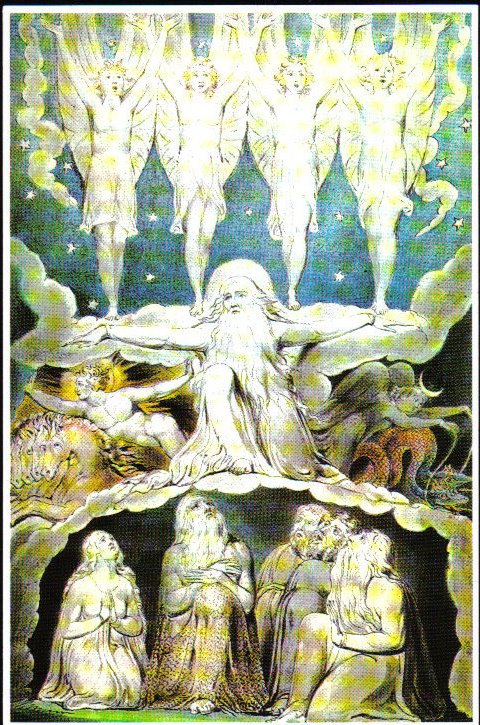
Artist: William Blake.

Capote, to his editor, Robert Linscott, in 1947:

"I am working on the book and it is really my love and today I wrote two pages and oh Bob I do want it to be a beautiful book because it seems important to me that people try to write beautifully, now more than ever because the world is so crazy and only art is sane and it has been proven time after time that after the ruins of a civilization are cleared away all that remains are the poems, the paintings, the sculpture, the books."

Why is it that I so rarely show this kind of enthusiasm in my blog about writing? Why do I so often over-organize my thoughts and over-analyze the writing process?

I think I'm afraid people will think I'm a "flake" if I show too much enthusiasm.

Yet I don't think Capote is a flake when he writes, "...and oh, ... I do want it to be a beautiful book ... only art is sane." Nor was Dickey a flake when he described being so overtaken by the beauty of the writing process that he fell down to his knees in the middle of the street, felled by the power of that feeling.

I watched a documentary on PBS tonight, on Independent Lens. It was about John Trudell, a Native American activist, poet, and songwriter, whose wife and children died when their house was burned as a result of political unrest on the reservation, violence instigated by the US Government. You may know him from the movies. Trudell was in Thunderheart, and other films.

But, for Trudell, it isn't about being a "star." At the end of the documentary, he says something to the effect that he feels the purpose of his life is share his poems and his stories. He knows he is only one man and he isn't singlehandedly going to change the system.

He just wants to be a part of the exchange of information, of thought. He does this through writing because writing gives him a sense of of what it is to be alive. I think this was so for William Blake. He was animated through his art.

That is what I want, too, to feel alive by creating.

Sunday, April 09, 2006

Capote


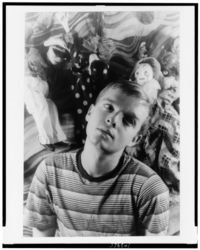
Photo: Truman Capote, 1924-1984.

I finally got to see Capote. Allen and I rented it and watched it on Saturday, along with Good Night and Good Luck and Broken Flowers.

After the movies, I did a bit of Internet research on the films and ran across Capote's burial site. This is a great site where you can find the graves of many of your favorite authors. I enjoy this site, although my family finds it morbid.

All night, after I'd gone to bed, the three movies swirled in my dreams, mixing with personal experiences. I can't say they were bad dreams, but very strange. I think the three movies together touched on many anxieties I have, both public and private.

Broken Flowers makes me think about how I have always feared coming to the end of my life and thinking that my life has had no meaning.

Good Night and Good Luck makes me think about inhumanity in the world, how politics and inhumanity become synonymous.

Capote certainly brings to the fore many thoughts about writing, why we do it, what the consequences of writing are. I believe so far in my blogs, I've only addressed the positive consequences of writing. Capote suggests there are places our writing can take us that are dangerous to our inner well-being. I have always thought there is a boundary in us, that, once crossed, destines us to be wanderers in our own lives, lost. Perhaps Truman Capote crossed that line.

Friday, April 07, 2006

Come to the Dark Side!


There's a dark side to each and every soul. We wish we were Obi-Wan Kenobi, and for the most part we are, but there's a little Darth Vader in all of us. Thing is, this ain't no either-or proposition. We're talking about dialectics, the good and the bad merging into us. You can run but you can't hide. My experience? Face the darkness. Stare it down. Own it. It's brother Nietzsche said, being human is a complicated gig. So give that ol' dark night of the soul a hug. Howl the eternal yes! --Chris in the Morning, Northern Exposure
~~~~~~~~~~~~~~~~~~~~~~~~~~~~~~~~

I've been writing so much about the dark side lately, I thought it'd be great to include one of my all-time favorite quotes here. This was actually my first post ever on my old AOL Journal.

I swear, I can't read this quote without smiling. It just makes me feel good!

Wednesday, April 05, 2006

The Treasure Trove


There is something dark in me, something among all my thoughts, something that I cannot measure with thoughts, a life that can’t be expressed in words and which is none the less my life…
--
Robert Musil, The Confusions of Young Torless


Kafka once wrote in one of his diaries: "The beginning of every story is ridiculous at first." I've always loved that because through the years it has encouraged me to start each new story without embarrassment or apology.

Once we finish the story, what then?

This has been on my mind the last two days. I have written a lot in my blogs about how stories come from a dark place in myself, a secret, hidden place which Jung called the unconscious. To use the title of one of my favorite poems by Adrienne Rich, it is like "Diving into the Wreck."

Often, though, this diving doesn't yield what I had hoped. Very often, I'm disappointed by what I write and have to acknowledge that the writing is nothing like what I'd envisioned. Recently, I came across a quote about this kind of disappointment:

“As soon as we put something into words, we devalue it in a strange way. We think we have plunged into the depths of the abyss, and then when we return to the surface the drop of water on our pale fingertips no longer resembles the sea from which it comes. We delude ourselves that we have discovered a wonderful treasure, and when we return to the light of the day we find that we have brought back only false stones and shards of glass; and yet the treasure goes on glimmering in the dark, unaltered.” (Maeterlinck, The Treasure of Homer.)

So my question would be, how do we keep from deluding ourselves? How do we even know whether we've brought up treasure and not just shards of glass?

Dreaming

Dreaming

About Me

My photo
Northwest Ohio, United States
"I was no better than dust, yet you cannot replace me. . . Take the soft dust in your hand--does it stir: does it sing? Has it lips and a heart? Does it open its eyes to the sun? Does it run, does it dream, does it burn with a secret, or tremble In terror of death? Or ache with tremendous decisions?. . ." --Conrad Aiken

Followers

Search This Blog

Epistle, by Archibald MacLeish

What I'm Listening To

My Music

Great Artists

www.flickr.com
This is a Flickr badge showing public photos from theresarrt7. Make your own badge here.

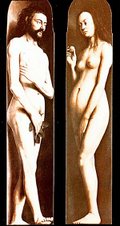
Fave Painting: Eden

Fave Painting:  Eden

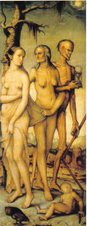
Fave Painting: The Three Ages of Man and Death

Fave Painting:  The Three Ages of Man and Death
by Albrecht Dürer

From the First Chapter

The Secret of Hurricanes : That article in the Waterville Scout said it was Shake- spearean, all that fatalism that guides the Kennedys' lives. The likelihood of untimely death. Recently, another one died in his prime, John-John in an airplane. Not long before that, Bobby's boy. While playing football at high speeds on snow skis. Those Kennedys take some crazy chances. I prefer my own easy ways. Which isn't to say my life hasn't been Shake-spearean. By the time I was sixteen, my life was like the darkened stage at the end of Hamlet or Macbeth. All littered with corpses and treachery.

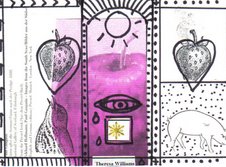
My Original Artwork: Triptych

My Original Artwork:  Triptych

Wishing

Wishing

Little Deer

Little Deer

Transformation

Transformation

Looking Forward, Looking Back

Looking Forward, Looking Back
CURRENT MOON
Powered By Blogger

Labels