Sunday, November 19, 2006

Note to myself

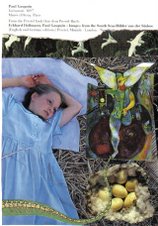
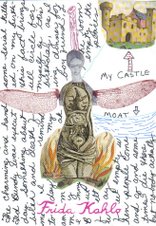
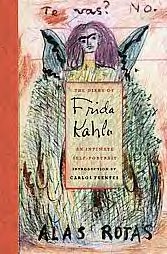
Photo: A page from Frida Kahlo's Journal

This is a note to myself: change the organization of the course, Theresa, so that you avoid the false dichotomy of mind/body. Instead, organize according to the students' required assignments:

(1) Creative Journal (show examples from the Journals of John Gardner, Theodore Roethke, Frida Kahlo, Kurt Cobain, Edvard Munch)

(2) Confession Postcard (show examples from Post Secret, my own postcards, postcards I received in the mail from bloggers and the people I met at Esalen)

(3) Photograph or painting (show examples from Frida Kahlo, Edvard Munch, Vincent Van Gogh, Philip Guston)

(4) Letter (share examples from Donald Hall, James Dickey, James Agee, James Wright, Vincent Van Gogh, Frida Kahlo,)

(5) Poem (share examples from St. John of the Cross, Theodore Roethke, John Berryman, John Ciardi, James Wright, Donald Hall, Robert Lowell, Frida Kahlo, Anne Sexton, and others)

a. Two kinds of poems, personal and confessional. More on this later.
b. Must discuss how to keep from seeming "Angsty" or "self-absorbed." More on this later.

(6) Prose (share examples of my own work, as well as examples from John Gardner, A. W. Frank, Dorothy Allison, James Agee, and others)

a. Prose to be workshopped during final 6 weeks of the course.
b. Three kinds of prose: essay, memoir or autobiographical fiction. More on this later.

Background reading on Art and Healing by: A. W. Frank, Viktor Frankl, Ernest Becker, Rollo May, Louise DeSalvo

Wednesday, November 15, 2006

From Angst to Art: Preliminary Outline

Last night I worked on a preliminary outline for my seminar, "From Angst to Art." My first impulse, of course, was to give students the time and space to create their own work of art drawing from their personal experience with angst. But every college course needs its backbone, its scholarship.

I plan to devote the first 8 weeks to artists and authors whose work was in some way "confessional." The term "confessional" in itself is something we will have to talk about because it has a certain derogatory meaning in academia. Robert Lowell, whose poetry originated the so-called confessional movement, really disliked the term. I don't dislike it because it puts me in the mind of a church confessional, which is a beautiful idea to me. I'm sure the students will have their own ideas.

Part of the goal of this course is to bring the healing aspect of art out of the shadows and give it the respect it deserves. Not only does the concept deserve respect, but I think a course like this could remove constraints students may have placed on themselves regarding their own reasons for making art. Generally, creative writing teachers run from the "art as therapy" idea like the plague because they want to avoid the maudlin-but-it-really-happened syndrome. I'd like to confront the problems inherent in using personal angst as a springboard for art head on, and perhaps offer some insights into how to avoid being self-absorbed. I still need to give more thought to this, especially about the prose I want to bring into the mix, but this is what I have so far:

The class material will be divided into two parts, the mind and the body. Since the students will be sharing their intimate experiences, I plan to also share mine.

I. Depression, Dark Night of the Soul, Mental Illness, Mortality
A. St. John of the Cross

B. Confessional Poets
1. Examples of bad (maudlin) poetry
2. Theodore Roethke/Nijinsky
3. James Wright
4. John Berryman
5. Robert Lowell
6. Adrienne Rich's "Diving into the Wreck"

C. Painters
1. Edvard Munch
2. Van Gogh
3. Philip Guston

D. Stories
1. "Blue Velvis"
2. Secret of Hurricanes
3. John Gardner

E. Non-fiction
1. Rollo May
2. John Gardner
3. Ernest Becker
4. Writing as a Way of Healing, Louise DeSalvo


II. The body: injury, illness, mortality
A. Frida Kahlo
B. Sociologist A.W. Frank, Wounded Storyteller as well as various articles

Monday, November 13, 2006

Creativity is not

... merely the innocent spontaneity of our youth and childhood; it must also be married to the passion of the adult human being, which is a passion to live beyond one's death. --Rollo May

Pain of unreturned love...

Walt Whitman once wrote of the pain of unreturned love, saying, "Now I think there is no unreturn'd love, the pay's certain one way or another. (I loved a certain person ardently and my love was not return'd, yet out of that I have written these songs.)"

Sunday, November 12, 2006

On November 12

I know the following seems like an odd thing to commemorate, but I have a few reasons for doing so. The reason I can talk about here is that I plan on talking about Theodore Roethke next semester in my seminar, "From Angst to Art." Maybe I will write about the seminar in this blog, examining how my thoughts shift and grow over the course of the semester.

I've always wanted to teach a course on literature and survival or writing and healing. I don't believe that all artists create because they are striving through their art to be whole, but the artists who are most interesting to me do. For a long time, I was ashamed to admit my writing was a form of healing; I was afraid my work would be diminished in others' eyes because of that. After researching, however, I've become emboldened to talk about it and to weave this philosophy into my teaching.

For a short time, I kept a separate blog on my teaching life. I did this because I felt my teaching life was destroying my creative life. Thankfully, my position at the University has changed, and I'm getting more opportunity to teach literature and creative writing all the time. In fact, after this academic year, I will no longer teach freshman composition at all. I love teaching freshmen, and I don't mind teaching composition, but it's so much work, so much grading, so much attention to technical detail and departmental requirements, that I feel wrung out like a washcloth by the time each semester ends. Now, my "two lives" can become the same, so I will soon be deleting the teaching blog and will talk more about my teaching here.

For over a year now, Roethke's life and work have consumed my attention. I've been on Amazon and ordered every book, new or used, that has been written about him. I'd known his poem, "The Waking" for many years, of course, but I really knew little about Roethke until quite recently. Roethke was a dynamic man, passionate and driven.

When he was in his late twenties, he had a psychotic episode, and he was to continue to have trouble and be in and out of hospitals all his life. He even had shock treatments at one point. Through it all, he kept writing. It has been fascinating for me over the past year to read of how his poetry helped him to know himself better, to tunnel toward the divine. "We think by feeling," he wrote in "The Waking." I remember this line every day of my life because that's how I want to live my life, that's the kind of teacher I want to be.

I love the month of November. The earth goes into hibernation and the rain and snow break down the leaves into mulch for worms. The hardwoods stand naked and you start to get the first really cold days and nights of the season. I wonder what it was like for Roethke, a young man just starting out in his career as a teacher and poet, wandering around on that cold November night, losing his shoe and thinking he'd suddenly found himself closer to God?

Bless you, Ted Roethke, wherever your spirit may be. Bless you and thank you for your poems.
-------------------------------------


From the Literary Notebook:

On this day in 1935, 27-year-old Theodore Roethke was hospitalized for the first of the manic-depressive breakdowns that would recur throughout his life. Roethke had just begun a teaching post at Michigan State University and, according to colleagues, had been drinking heavily all semester, dozens of cups of coffee and bottles of cola a day as well as alcohol. On the previous evening, a cold one, he had taken a long walk in the woods without a coat and eventually with only one shoe; the next morning, after deciding "to cut my eight o'clock class deliberately just to see how long they would stick around," Roethke took another walk in the woods, also coatless. He was shivering and delirious when he arrived at the dean's office, where he planned "to explain one or two things about this experiment"; the dean, trained as a mathematician, called for the doctors. Roethke later told friends that while on his first walk he had had a mystical experience with a tree -- even pointed out the tree, while retrieving his shoe. The tree taught him "the secret of Nijinsky," he said, perhaps referring to that passage in Nijinsky's diary -- written while Nijinsky was a mental patient -- that describes learning from a tree that "human beings do not understand feelings."
Dreaming

Dreaming

About Me

My photo
Northwest Ohio, United States
"I was no better than dust, yet you cannot replace me. . . Take the soft dust in your hand--does it stir: does it sing? Has it lips and a heart? Does it open its eyes to the sun? Does it run, does it dream, does it burn with a secret, or tremble In terror of death? Or ache with tremendous decisions?. . ." --Conrad Aiken

Followers

Search This Blog

Epistle, by Archibald MacLeish

What I'm Listening To

My Music

Great Artists

www.flickr.com
This is a Flickr badge showing public photos from theresarrt7. Make your own badge here.

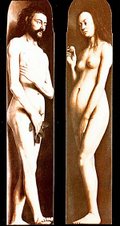
Fave Painting: Eden

Fave Painting:  Eden

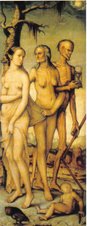
Fave Painting: The Three Ages of Man and Death

Fave Painting:  The Three Ages of Man and Death
by Albrecht Dürer

From the First Chapter

The Secret of Hurricanes : That article in the Waterville Scout said it was Shake- spearean, all that fatalism that guides the Kennedys' lives. The likelihood of untimely death. Recently, another one died in his prime, John-John in an airplane. Not long before that, Bobby's boy. While playing football at high speeds on snow skis. Those Kennedys take some crazy chances. I prefer my own easy ways. Which isn't to say my life hasn't been Shake-spearean. By the time I was sixteen, my life was like the darkened stage at the end of Hamlet or Macbeth. All littered with corpses and treachery.

My Original Artwork: Triptych

My Original Artwork:  Triptych

Wishing

Wishing

Little Deer

Little Deer

Transformation

Transformation

Looking Forward, Looking Back

Looking Forward, Looking Back
CURRENT MOON
Powered By Blogger

Labels